Kategorie: Film production / Converting

In addition to the usual mechanical tests, special tests for special applications are increasingly playing a role here. If the film is smooth enough, it is suitable for the machine type for processing. We provide answers to these complex but simple-sounding questions.

  • Plastics in paper packaging

    Plastics in paper packaging

    Part 2: Important coating polymers

    In the first part of our series on plastic content in paper-based packaging for food and consumer goods, we focused on the reasons for using plastic layers and typical functional requirements – without going into specific types of polymers. In part 2, we now turn our attention to individual, sometimes specialised plastic materials and plastic substitutes that are used specifically to achieve certain functional properties. We look not only at conventional plastics, but also at bio-based and alternative materials that are important in terms of barrier effect, sealability and surface protection, as well as from an environmental and regulatory perspective. Our focus is on plastics in paper packaging: from PE to bio-based polyesters – an overview of functions, environmental aspects and regulatory requirements.

    Polyethylene (PE) 

    Polyethylene is the plastic most commonly used in paper-based packaging, usually applied as a thin coating on cardboard or paper. It primarily serves as a moisture and grease barrier, ensuring that liquids or oils do not penetrate the paper fibres. At the same time, PE’s thermoplastic properties enable reliable sealability, which is particularly important for bags, cups and food cartons. PE is chemically inert, food-safe and relatively inexpensive, which explains its widespread use. From an environmental point of view, however, it is problematic because it can only be separated from the fibre material in paper recycling through complex processes and remains persistent in nature. More recycling-friendly variants, such as thinner coatings or modified PE types, are currently being developed to improve the recyclability of paper-PE composites.

    Styrene acrylate copolymers 

    Styrene acrylate copolymers combine the properties of styrene and acrylic acid esters. In paper-based packaging, they are primarily used as binders in barrier or protective coatings, where they provide adhesion, mechanical stability and water resistance. They are also found in certain adhesives and printing inks, where they contribute to a robust, durable surface.

    Acrylate polymers 

    Acrylate polymers (pure acrylates) are frequently used in adhesives for labels and packaging tapes. They are characterised by strong adhesion, UV and moisture resistance, and temperature stability. In addition to adhesives, acrylates are also used as transparent coatings on films or paper to improve barrier properties against gases and aromas without compromising printability or optical quality.

    Polysiloxanes

    Polysiloxanes, also known as silicones, are primarily used in packaging as ultra-thin coatings or additives. For example, they serve as a non-stick or release layer on paper substrates, such as label backing papers, so that adhesive surfaces can be easily removed. When added in small quantities, polysiloxanes also improve the processability and lubricity of coatings, such as in the coating of paper. Due to their temperature and chemical resistance, they are suitable for many food contact applications.

    Polyhydroxybutyrate (PHB) 

    PHB belongs to the family of bio-based polyhydroxyalkanoates (PHA) and is produced by microorganisms from renewable raw materials. It is completely biodegradable and can replace polypropylene in certain applications. PHB is rigid, dimensionally stable and suitable for direct food contact, but it is more brittle and heat-sensitive than many conventional plastics. In paper composites, it can serve as a coating or film layer, especially in compostable disposable packaging.

    Bio-based polyesters 

    Bio-based polyesters comprise a range of materials that are made entirely or partially from renewable raw materials. A well-known example is polylactic acid (PLA), which is compostable under industrial conditions and is used in the form of films, trays or paper coatings. Other bio-based polyesters include PEF, which can replace PET, and PBS or PBAT, which are used for compostable films and bags. These materials offer potential for reducing fossil raw materials, but face challenges such as limited heat resistance or limited recycling infrastructure.

    Conclusion 

    The materials presented, which are not an exhaustive list, complement the range of functional plastics in paper-based packaging and demonstrate the wide variety of options available for achieving specific properties such as barrier effect, sealability or surface protection. Their choice depends heavily on technical requirements, regulatory compliance and environmental goals – an area that is likely to become even more dynamic in the coming years.

    Coating Properties Production volume (rough estimate)
    Polyethylene (PE) Moisture and grease barrier, thermoplastic, food-safe, cost-effective6 million tonnes
    Styrol-Acrylat-Copolymers Adhesion, mechanical stability, water resistance, in adhesives and printing inks1.5 million tonnes
    AcrylatpolymersStrong adhesion, UV and moisture resistance, temperature stability2 million tonnes
    Polysiloxanes Non-stick or release coating, temperature and chemical resistance500,000 tonnes
    Polyhydroxybutyrate (PHB) Biodegradable, rigid, dimensionally stable, suitable for food contact 200,000 tonnes
    Bio-based polyesters Compostable, reduction in fossil raw materials, limited heat resistance300,000 tonnes

    List of sources for research on the various coatings used on paper:

    1. Packoi. “PE Coated Paper.” Access on 3 September 2025. [https://packoi.com/de/blog/pe-coated-paper/](https://packoi.com/de/blog/pe-coated-paper/). 
    1. Siegwerk Druckfarben AG & Co. KGaA. “Paper Coating Guide.” Access on 3 September 2025. [https://www.siegwerk.com/fileadmin/Data/Documents/Publications/Flyer/210_297_4C_SW_Flyer_PaperCoatingGuide_DE_Final.pdf] (https://www.siegwerk.com/fileadmin/Data/Documents/Publications/Flyer/210_297_4C_SW_Flyer_PaperCoatingGuide_DE_Final.pdf).
    1. Guyenne Paper. “Coating: What is it?” Access on 3 September 2025. [https://www.guyennepapier.com/de/blog/detail/beschichtung-was-ist-das/).

    Author: Dr. Daniel Wachtendorf, Innoform GmbH August 2025
  • Plastic-Free” on Paper Cups with Acrylate Coating? – New Statement from ALS

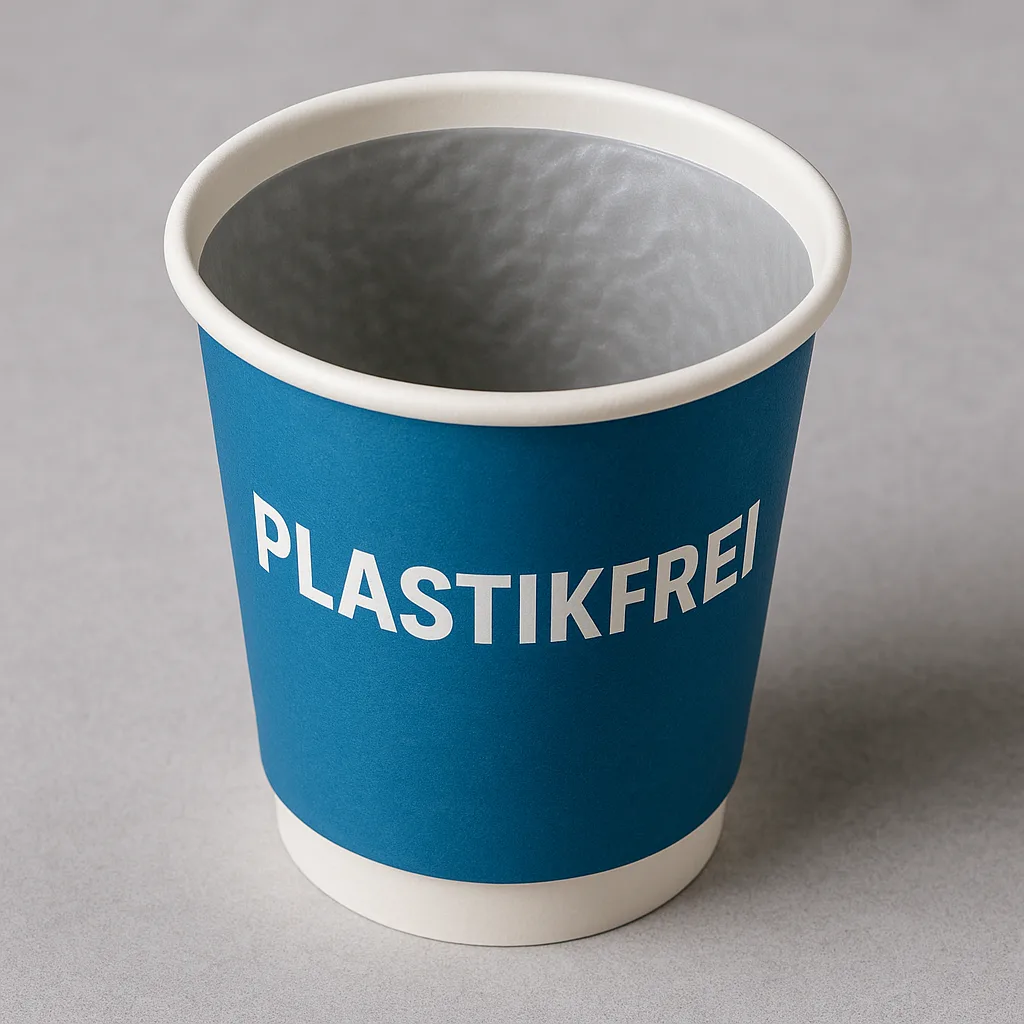
    Plastic-Free” on Paper Cups with Acrylate Coating? – New Statement from ALS

    The Working Group of Food Chemistry Experts of the Federal States and the Federal Office of Consumer Protection and Food Safety (ALS) published a statement on coatings of food contact materials made from cardboard at their 124th meeting. Specifically, the statement addresses paper cups and similar products coated with acrylate-styrene copolymers (e.g., acrylonitrile-styrene-acrylate copolymer) to create a moisture barrier.

    Key Points of the Statement

    • Definition of “Plastic”: According to EU regulations (Regulation (EU) No 10/2011, Single-Use Plastics Directive and Labeling Regulation), polymers are generally classified as plastics. This also includes acrylate-styrene copolymers in coatings and varnishes.
    • Risk of Misleading Claims: If a coated paper cup is advertised as “plastic-free” or “free from plastic,” this constitutes misleading information within the meaning of Article 3(2) of Regulation (EC) No 1935/2004 and Section 33(1) LFGB. Reason: Consumers associate these claims with environmental benefits that do not actually exist.
    • Assessment Consequences: For evaluation purposes, it is decisive that the coatings used are synthetic polymers. Accordingly, they must be legally classified as plastic.

    Practical Implications

    For manufacturers and distributors of food packaging, this means: Advertising coated paper packaging as “plastic-free” is not permissible if polymer-based coatings are used. Otherwise, legal consequences for misleading claims may result.

    Source

    The complete statement can be found on the BVL homepage: www.bvl.bund.de/als

    Download original text: https://www.bvl.bund.de/SharedDocs/Downloads/01_Lebensmittel/ALS_ALTS/ALS_Stellungnahmen_124_Sitzung_2025.pdf?__blob=publicationFile&v=2

    If you would like to have products tested for plastic-free status, contact Dr. Daniel Wachtendorf +49 441 94986-22 and find out more here:

  • 19th Amendment of the Plastics Regulation (EU) No. 10/2011

    19th Amendment of the Plastics Regulation (EU) No. 10/2011

    New regulations for plastics in food contact by Regulation (EU) 2025/351 have been published.

    Important amendments to the EU regulations on plastic food contact materials are presented here. These include amendments to Regulation (EU) No. 10/2011, amendments to Regulation (EU) 2022/1616 on recycled plastics and amendments to Regulation (EC) No. 2023/2006 on good manufacturing practice.

    Important clarifications concern the definitions and requirements for plastics, the introduction of “UVCB substances”, purity requirements, regulations on reprocessing and recycling, new labelling regulations and extended declarations of conformity. In addition, rules on conformity testing and transition periods are specified.

    1. Amendments to existing regulations:
      • Amendments to Regulation (EU) No. 10/2011 on plastic materials and articles that come into contact with food.
      • Amendments to Regulation (EU) 2022/1616 on recycled plastics and repeal of Regulation (EC) No 282/2008.
      • Amendments to Regulation (EC) No 2023/2006 on good manufacturing practice.
    1. Clarifications and precisions:
      • Definitions and requirements for the composition of plastics have been specified.
      • Introduction of the term “UVCB substances” (substances with unknown or variable composition).
      • Extent and nature of evidence to demonstrate compliance and composition of starting materials at each stage of the manufacturing process
    1. Purity requirements:
      • Specification of high purity levels for substances used in the manufacture of food contact materials.
      • Specific regulations for the purity of substances of natural origin.
    2. Reprocessing and recycling:
      • Regulations for the reprocessing of plastic by-products.
      • Requirements for quality assurance systems in recycling plants.
    3. Labelling and declaration of conformity:
      • New labelling regulations for reusable food contact materials.
      • Extended requirements for the declaration of compliance, including information on not intentionally added substances (NIAS)
    4. Examinations
      • Rules on conformity testing and assessment of compliance with limit values clarified
      • Criteria for assessing the stability of reusable materials and objects
    5. Transition periods:
      • 18 months first placing on the market
      • 9 months before the end of the transition period, information of the customer if the requirements have not yet been met.

    You can find the regulation here: Regulation – EU – 2025/351 – EN – EUR-Lex

    Contact: Heike Schwertke

  • Specifications – Much More Than Just Necessary Paperwork

    Specifications – Much More Than Just Necessary Paperwork

    Specifications often seem like time-consuming bureaucracy – yet they are indispensable for quality, efficiency and legal certainty. Packaging specifications, for example, are crucial for the protection of products. This article uses illustrative practical examples to show why well-considered specifications not only ensure quality and clarity, but also reduce economic risks and, in emergencies, can even protect against personal liability.

    Specifications vs. Data Sheets

    At first glance, specifications often seem like a bureaucratic evil, but packaging specifications can reduce this complexity: extensive, complex and time-consuming. In fact, however, they are essential for sustainable quality assurance and economic success in almost every production process – especially in the field of packaging. Their careful preparation is by no means pure bureaucracy, but rather an investment in long-term quality assurance, clarity and efficiency.

    But why is it so important to clearly distinguish between packaging specifications and simple data sheets? Data sheets generally serve only for quick information, often contain target values and deliberately omit binding tolerances. They provide initial information about a product and are usually influenced by marketing departments – informative, but not legally binding. Specifications, on the other hand, contain binding requirements with clearly defined tolerances, standards and test methods. These details ensure clear communication between customers, suppliers and internal departments.

    Consequences of Unclear Document Types

    In practice, it regularly becomes apparent that a lack of clarity between data sheets and specifications can lead to significant problems. In numerous audits, the mixing of these document types leads to deviations and even to serious, so-called “major deviations”. The result is unnecessary costs, considerable additional effort and potential damage to the company’s image.

    The advantages of clear specifications are not only evident in audit situations, but particularly in daily operations. Packaging specifications reduce misunderstandings, minimize complaints and sustainably strengthen customer-supplier relationships. The initial time investment in their creation therefore typically pays off quickly through lower consequential costs.

    Practical Example: Color Change in Expanded Clay Packaging

    An impressive example from practice underscores the benefits of clear specifications: A few years ago, a company changed the printing ink for packaging of expanded clay products. Although the new printing ink initially showed advantages in the processing, products stored outdoors experienced unexpected and significant color changes. Thanks to a precise specification, however, the problem was quickly identified and a pragmatic solution was found together with the customer. Instead of expensive complaints or the destruction of entire batches, the goods were sold with a price discount for indoor storage – a classic win-win situation for both sides. Without packaging specifications, such a quick and clear solution would have been virtually impossible.

    Legal Protection Through Specifications

    However, specifications not only serve practical purposes, they also provide crucial legal protection. A dramatic example illustrates this: A manufacturer of baby food used packaging that did not meet the specified requirements in one batch, which led to serious product failures. Although it ultimately turned out that no serious consequences had occurred, quality managers were personally prosecuted and even charged. Thanks to the existing specification, which was clear and unambiguous, those responsible were able to prove that they had fulfilled their duty of care and emerged unscathed. Without this specification, personal liability might have turned out to be more dramatic.

    Specifications as a Dynamic Quality Instrument

    Another aspect that speaks in favor of packaging specifications is their role as a dynamic quality instrument. We do not treat specifications as static documents, but review and adapt them regularly. When production processes change, new raw materials are added or new regulatory requirements apply, we take this into account immediately – this is how we continuously develop and improve our specifications.

    The definition of realistic and sufficiently broad tolerances plays an important role here. A well-chosen tolerance limit takes real production fluctuations into account without compromising quality. If we set tolerances too narrow, we unnecessarily create waste and drive up costs, while tolerances that are too wide endanger product safety. Precise knowledge of production processes is essential here to establish economically and qualitatively sensible limits.

    Conclusion and Outlook

    In summary, it can be stated that: Packaging specifications are not a troublesome burden, but a central foundation of successful, sustainable business relationships. They not only ensure quality, but also provide legal protection and help avoid costly disputes. Those who understand specifications not just as a mandatory exercise, but as an essential tool for quality assurance, ultimately also increase the efficiency and profitability of their company.

    Training offerings can be found here: innoform-coaching.de/themen/folienpruefung-spezifikation-normen-co

    Your contact person in our test service regarding specifications is Matthias Böhne: 0441 94986-11

  • The gelbo flex test according to ASTM F 392

    The gelbo flex test according to ASTM F 392

    Innoform Testservice frequently receives requests to test the mechanical strength of flexible (barrier) materials. These materials play a crucial role in many applications, from food packaging to technical protective films. A proven method for testing the mechanical strength of these materials is the gelbo flex test in accordance with ASTM F 392, which focuses in particular on the crease and buckling resistance of barrier materials such as film or paper laminates.

    What is the gelbo flex test?

    The gelbo flex test simulates the stresses to which flexible films are exposed during use. A film sample is stretched onto two rings in the shape of a tube and exposed to repeated pressure and squeezing movements. The intensity and frequency of these movements can be varied to simulate different application scenarios. When performing the test, a distinction is made between two main types, complete and partial twisting. These different methods make it possible to accurately simulate the specific requirements of different applications.

    After loading: testing the samples

    After the mechanical stress caused by the yellow flex test, the film samples can be further analysed in two ways:

    Optical examination for pinholes: In this case, the sample is checked for small holes or weak points that may have been caused by the mechanical stress. This can be done either with the aid of a light table or a special test liquid. These pinholes may significantly affect the barrier properties. 2. permeation test: Using this method, the barrier effect of the stressed sample is compared with that of an untreated sample. This shows the extent to which the mechanical load influences the film’s ability to retain gases or water vapour.

    Why is the gelbo flex test important?

    In practice, high demands are placed on flexible materials. The yellow flex test offers a standardised method for evaluating the mechanical strength of these materials under realistic conditions. This enables manufacturers and users to ensure the quality and reliability of their products.

    Conclusion

    Innoform Testservice is your competent partner for testing the mechanical strength of flexible materials. With the gelbo flex test in accordance with ASTM F 392, we offer you a reliable method for testing and optimising the strength and barrier properties of your materials. Trust in our expertise and experience to ensure the quality of your products. www.innoform-testservice.de

    Video Innoform Testservice
  • 11th amendment of Regulation (EU) no. 10/2011 has been published

    11th amendment of Regulation (EU) no. 10/2011 has been published

    With the 11th amendment of Regulation (EU) no. 10/2011 two new substances have been added to the list of substances in annex I, and the specific migration limit for two listed substances (perchloric acid, salts (perchlorate) (FCM No 822) and phosphorous acid, mixed 2,4-bis(1,1-dimethylpropyl)phenyl and 4-(1,1-dimethylpropyl)phenyl triesters (FCM substance No 974 and CAS No 939402-02-5) have been amended. Plastic materials and articles complying with Regulation (EU) No 10/2011 as applicable before the entry into force of this Regulation, may be placed on the market until 26 June 2019 and may remain on the market until exhaustion of stocks. Please find here the regulation in different European languages: https://eur-lex.europa.eu/legal-content/DE/TXT/?uri=CELEX:32018R0831