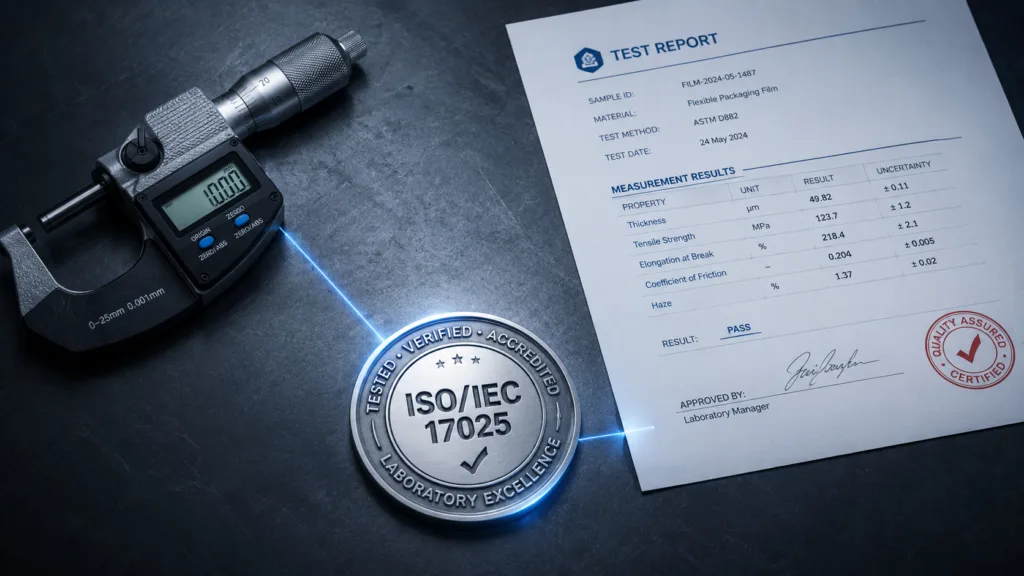
The accreditation of a testing laboratory according to ISO/IEC 17025 is considered the international gold standard of laboratory qualification. But what lies behind the certificate – and is the effort really worth it? A sober look at requirements, processes and concrete added value.
What is ISO/IEC 17025 – and why is it relevant?
ISO/IEC 17025 is the globally applicable standard for the competence of testing and calibration laboratories. It is issued by national accreditation bodies – in Germany by DAkkS (Deutsche Akkreditierungsstelle GmbH) – and forms the basis for international recognition of test results within the framework of multilateral agreements (e.g. ILAC MRA).
Without accreditation, test reports in many regulated areas – food safety, medical devices, packaging, construction – are simply not marketable.
The accreditation process: What laboratories actually have to deliver
Initial certification is not a one-time administrative act. The standard requires a fully documented management system that equally covers structural, personnel and technical requirements. Key obligations include:
- Proof of personnel competence – qualification, training records and regular assessment of all testing staff
- Traceability of measurements – calibration of all measuring equipment according to national and international reference standards
- Validation and verification of test methods – in-house developments and standards-based methods must be demonstrably mastered
- Environmental conditions and equipment management – controlled, documented test conditions as a prerequisite for reproducible results
- Impartiality and confidentiality – structural measures against conflicts of interest, anchored in the organizational structure
In addition, there are regular internal audits, management reviews and external surveillance audits by the accreditation body – typically on a two-year cycle, with complete reassessment after five years.
The real effort – clearly quantified
Honesty is required here: initial accreditation ties up considerable resources. Experience shows that medium-sized laboratories must plan for six to twelve months lead time. The main burden lies in creating and maintaining a quality management system, method validation, and training and qualification of personnel.
Ongoing costs arise from calibration cycles, proficiency tests for method confirmation, and the administrative burden of auditing. Those who underestimate this effort endanger not the certificate – but the credibility of the entire operation.
The added value: What accreditation means for laboratories and their clients
- For the laboratory:
Systematically better processes, reduced error rates, clear responsibilities and a structured basis for the further development of test methods. Accreditation creates internal commitment that is often lacking without external pressure. - For the client:
Accredited test reports are internationally recognized and admissible in court. The traceability of every measurement to SI units and the complete documentation create a level of trust that no ISO 9001 certificate alone can achieve. For companies with regulated supply chains, commissioning an accredited laboratory is not optional – it is mandatory.
Conclusion: Accreditation is not an end in itself
ISO/IEC 17025 is demanding, expensive and elaborate. That is precisely its value. Laboratories that consistently implement this standard deliver measurably more reliable results – and their clients can make well-founded decisions on this basis.
Accreditation is not a marketing tool. It is technical proof that must be earned anew every day.
Would you like to know whether your test results are prepared on an accredited basis? Contact us – we will guide you through the entire process, transparently and without promises we cannot keep.