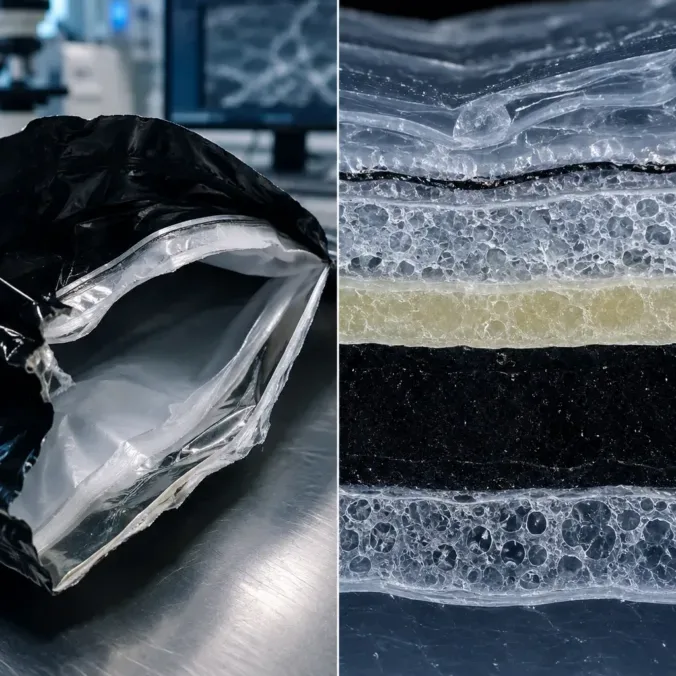
Packaging quality issues rarely occur without warning. Suddenly a sealing seam opens unexpectedly, the bond comes apart, barrier properties deteriorate or processing problems accumulate in production. The visible symptoms are often clear – but the actual causes are not.
This is exactly where the damage analysis begins. And in many cases the first route leads to material analysis.
Why the actual cause often remains hidden
When an error occurs, the focus is often initially on the production process. Have machine parameters been changed? Were there any fluctuations in processing? Are the conditions in the warehouse responsible?
These questions are important. Nevertheless, practice shows again and again that the actual cause often lies in the material itself.
Even small changes in the raw material, layer structure or material properties can have a significant impact on the functionality of packaging. The problem: Such changes are usually not visible to the naked eye.
A systematic material analysis helps to replace assumptions with facts.
Typical damage patterns with flexible packaging
Many quality problems can be traced back to some recurring damage patterns.
Let the damage speak for itself through appropriate analysis and thereby understand errors in depth before measures are implemented.
Karsten Schröder
Delamination of composite materials
If individual layers separate from one another, adhesion promoters, adhesives or process parameters may be the cause. Material changes on the supplier side are also conceivable.
Abnormalities when sealing
Insufficient seam strength or unstable sealing parameters can indicate changes in the sealing layer, contamination or unsuitable material combinations.
Change in barrier properties
If oxygen or water vapor permeability increases unexpectedly, it is worth taking a closer look at the layer structure and the barrier materials used.
Processing problems
Wrinkling, web instability or unexpected friction properties can be caused by material fluctuations or different raw material qualities.
In all of these cases the same question arises: Does the material actually meet the expected properties?
Material analysis as a tool for root cause research
Modern analyzes enable significantly deeper insight than classic incoming goods inspections.
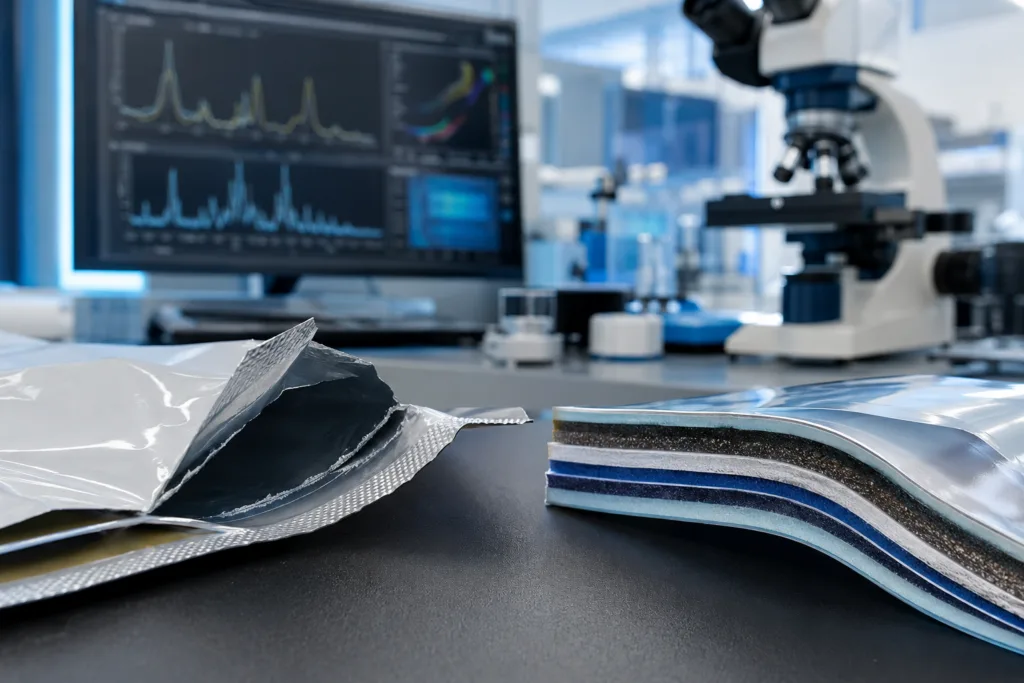
Material identification using FTIR
With the help of infrared spectroscopy (FTIR), plastics and other materials can be identified and compared with each other.
This makes it possible to check whether the materials used actually correspond to the intended materials or whether there are deviations.
Examination of the layer structure
Especially with composite films, the exact composition determines the subsequent function of the packaging.
Microtome sections and microscopic examinations make individual layers visible and allow statements to be made about material combinations, layer thicknesses and structural structure.
Thermal analyses
Methods such as DSC analysis (Differential Scanning Calorimetry) provide information about melting behavior, crystallinity and material composition.
This allows differences between the target and actual states to be recognized, which have a direct impact on processing and function.
Why guesses often become expensive
Time pressure often arises when processing complaints. Production stoppages, delivery bottlenecks or quality deviations require quick decisions.
However, this is exactly where there is a risk: If causes are only assumed, there is a risk that measures will be targeted at the wrong adjustment screws.
Machine parameters are adjusted, processes are changed or suppliers are changed without the actual cause being clearly identified.
A well-founded material analysis, on the other hand, creates a reliable basis for decision-making and often shortens the path to actually solving the problem.
Material analysis is more than just processing complaints
Damage analysis is often only commissioned when a problem has already arisen. Material analysis can also be used preventatively.
Typical fields of application are:
- Reviewing new supplier materials
- Comparison of alternative qualities
- Securing material changes
- Evaluation of recycled content
- Quality monitoring in goods receipt
- Documentation for critical applications
If you understand material properties early on, you can avoid many later problems.
Conclusion
Packaging provides clues as to its errors – you just have to be able to read them correctly. While visible damage often only represents symptoms, the actual causes often lie in the material structure or in changed material properties.
Material analysis provides the necessary facts to evaluate quality problems in a well-founded manner and to systematically narrow down the causes. It is therefore a central tool for damage analysis and supports companies in making well-founded decisions instead of reacting to assumptions.
Our tip
If quality deviations occur or material changes are suspected, it is worth taking an analytical look at the packaging itself. Modern testing methods can provide valuable information and help to identify causes more quickly and reliably.
Frequently Asked Questions (FAQ)
What is special about material analysis for packaging? +
Material analysis identifies the chemical composition, melting point (DSC), and precise layer structure of packaging films using spectroscopic and microscopic methods.
When does failure analysis help? +
It helps with complaints such as seal seam failures, delamination (peeling of film layers), or insufficient barrier properties to find the exact root cause and resolve costly process defects.
Which devices are used for material analysis? +
Standard equipment in our accredited laboratory includes FTIR spectrometers for material identification, DSC measuring instruments for thermal analysis, and high-resolution optical microscopes for layer thickness measurements on microtome cross-sections.