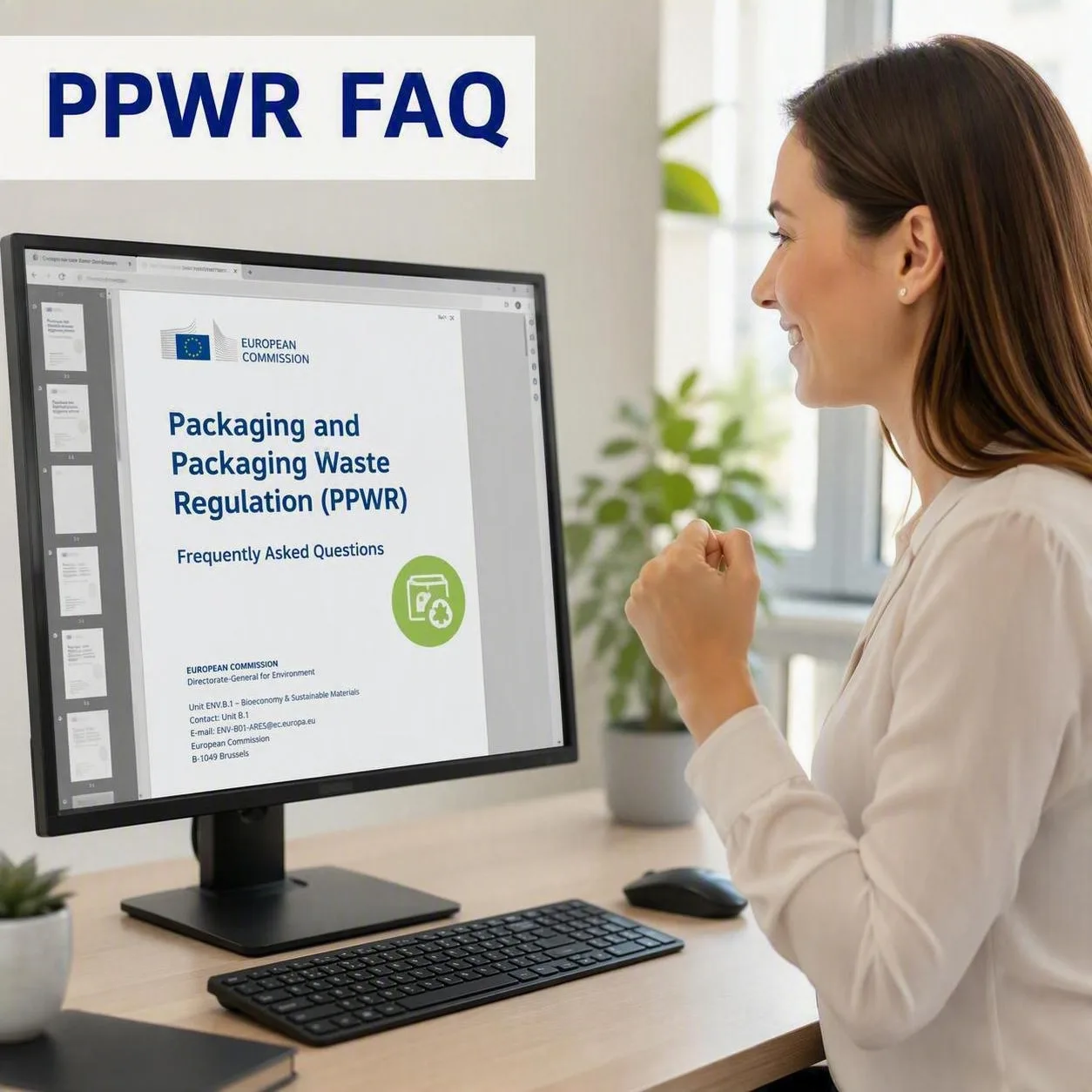
Since 12 August 2026, the Packaging and Packaging Waste Regulation (PPWR) has applied in the European Union. For the flexpack industry, this marks the beginning of a new era. Although many of the more technically demanding requirements will only enter into force in the coming years, manufacturers, converters, brand owners, and importers must already fulfill numerous new obligations today.
The second edition of the European Commission’s FAQ, published in August 2026, provides key clarifications on this matter and can serve as a practical working guide for PPWR managers.
The document is particularly valuable for manufacturers of flexible packaging. Many questions directly concern topics such as printing inks, adhesives, barrier coatings, film laminates, transport packaging, or the future use of recyclates.
A document full of practical answers
The FAQ comprises over 60 pages and answers questions that have arisen in companies, associations, and authorities since the publication of the PPWR. For PPWR managers, it provides concrete guidance on topics such as:
- PFAS limit values in food contact packaging
- Handling of printing inks, varnishes, and adhesives
- Definition of manufacturer and producer roles
- Verification and technical documentation
- Recyclability of packaging systems
- Recyclate use in plastic packaging
- Declarations of conformity
- Reuse and refill requirements
- Packaging minimization and void space requirements
This makes the FAQ almost a practical handbook for implementing the new regulation.
„The PPWR applies to all packaging placed on the EU market, whether empty or filled, regardless of the material used.“
This quote clearly illustrates why virtually every company in the packaging value chain must address the PPWR. Whether mono-material film, laminated structure, barrier pouch, stand-up pouch, or shipping packaging: the requirements apply regardless of the material used.
PFAS, printing inks, and adhesives particularly relevant for Flexpack
One focus of the new FAQ is on substances with critical properties, the so-called “Substances of Concern” (SoC). Of particular interest to the flexpack industry is the clarification that the new PFAS limits apply to the entire packaging unit.
The commission explicitly clarifies that not only the substrate film is considered, but also printing inks, varnishes, coatings, adhesives, and other components of the packaging. Likewise, it makes no difference whether PFAS were intentionally added or are unintentionally present.
For many packaging manufacturers, this means much closer cooperation with raw material suppliers and a systematic evaluation of their formulations.
Documentation becomes a mandatory task
While many sustainability requirements will only become binding from 2030, the obligations for manufacturers and proof of conformity apply already today.
The FAQ emphasizes multiple times that ultimate responsibility always lies with the manufacturer or the economic operator defined as the manufacturer. Suppliers can provide information, but the legal responsibility remains with the entity placing the product on the market.
Particularly helpful for companies are the explanations regarding:
- technical documentation,
- manufacturer markings,
- batch and traceability systems,
- declarations of conformity,
- transitional arrangements for existing stock.
Medium-sized flexpack companies in particular thus receive concrete guidance for the first time on how these requirements can be implemented in practice.
Design for Recycling becomes a strategic priority
Many companies are currently focusing on the regulations that apply immediately. However, the FAQ clearly shows that the real changes are yet to come.
From 2030, packaging must be recyclable. In the future, packaging units will be viewed as an overall system. For flexible packaging, this means in particular that not only the main film is evaluated, but also integrated components such as closures, labels, or coatings. Non-recyclable components can downgrade the rating of the entire package.
For manufacturers of stand-up pouches, flow packs, lidding films, or laminated films, the question is therefore becoming increasingly important:
How does Design for Recycling actually become a marketable and PPWR-compliant packaging concept?
It is precisely at this point that the FAQ provides initial interpretations and helps to better contextualize future developments.
Use of Recyclates: The Clock is Ticking
The requirements for recyclate content also raise many questions. The FAQ contains numerous examples of how future minimum quotas will be applied.
Of interest to the flexpack sector is the clarification that printing inks, adhesives, and varnishes are not considered plastic within the meaning of the recyclate requirements and are therefore not included in the calculation. At the same time, the Commission uses practical examples to explain how packaging types are to be evaluated in the future.
Reading the document is particularly worthwhile for packaging developers, quality managers, and sustainability officers, as many future interpretations are already discernible today.
Why the FAQ is also important for quality and regulatory teams
The FAQ does not only answer legal questions. It also assists in the practical organization of PPWR compliance.
Companies receive guidance on:
- what information they will require from suppliers in the future,
- how technical documentation should be structured,
- what evidence is required for declarations of conformity,
- how packaging can be made identifiable,
- what transitional arrangements apply to existing packaging.
The FAQ thus develops into an indispensable guide for regulatory affairs, quality management, packaging development, and procurement.
What does this mean in practice?
The new FAQ impressively demonstrates that the PPWR is far more than just a recycling regulation. In the coming years, it will occupy development, procurement, quality management, regulatory affairs, and sustainability departments alike.
For companies in the flexpack industry, it is recommended to start today to:
- systematically collect material data,
- update supplier declarations,
- conduct PFAS and substance evaluations,
- build up technical documentation,
- assess the recyclability of existing structures,
- develop recyclate strategies,
- take future Design for Recycling requirements into account at an early stage.
Conclusion
The European Commission’s updated FAQ is far more than a collection of questions and answers. For PPWR managers in the flexpack industry, it currently represents one of the most important practical tools for interpreting the new regulation.
Anyone wishing to understand and implement upcoming requirements early on will find numerous concrete pointers for operational practice. At the same time, it becomes clear that many crucial course settings must be made today, even though individual technical requirements will only become binding in 2030.
For testing laboratories, packaging developers, and brand owners, one thing is certain: the technical evaluation of materials, substances, and packaging systems will move even further into focus in the future. It is precisely here that independent testing, material analyses, and regulatory assessments can help identify risks early on and make informed decisions for future packaging solutions.
Link to the FAQ: https://environment.ec.europa.eu/publications/faq-packaging-and-packaging-waste-regulation-ppwr_en