The discussion around PFAS in packaging has gained significant momentum in recent months. At the latest with the PPWR limit values, many companies are facing the same question:
How can PFAS in flexible packaging be reliably detected – and which analytical approach is sensible?
As part of an Inno-Talk, Dr. Tim Schlüter (Innoform Testservice) presented the current state of analytics. The key finding:
“There is currently no harmonized analytical method – but there are practical ways to reliably assess PFAS.”
This is precisely where the expanded testing services at Innoform Testservice come in.
PFAS Analytics: Challenge and Reality
PFAS comprise a very large substance group with several thousand potential compounds. A complete individual substance analysis is therefore hardly feasible in practice.
At the same time, the PPWR demands clear limit values for food contact packaging. This creates a field of tension:
- very low limit values
- complex substance groups
- lack of standardized test methods
Analytics must therefore proceed pragmatically and work with suitable screening strategies.
Additional Challenge with Polyolefins
This is particularly relevant for polyolefins such as PE and PP, which make up a large proportion of flexible packaging systems.
In practice, PFAS are often deliberately used here:
- already in the raw material as an additive
- during film extrusion as a processing aid
The goal of these so-called processing aids is to:
- improve melt properties
- stabilize material flow in the extruder
- optimize the surface quality of the film
These functional additives can lead to measurable fluorine contents even in supposedly non-critical materials.
For assessment, this means:
PFAS entries are often system-inherent and not always fully documented. Analytical verification is therefore necessary.
Total Fluorine as Key to Quick Guidance
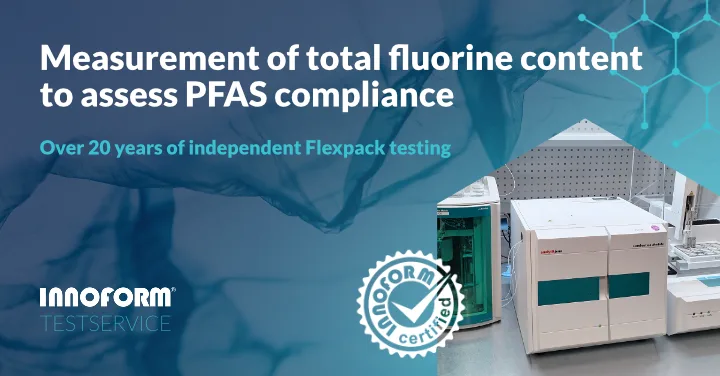
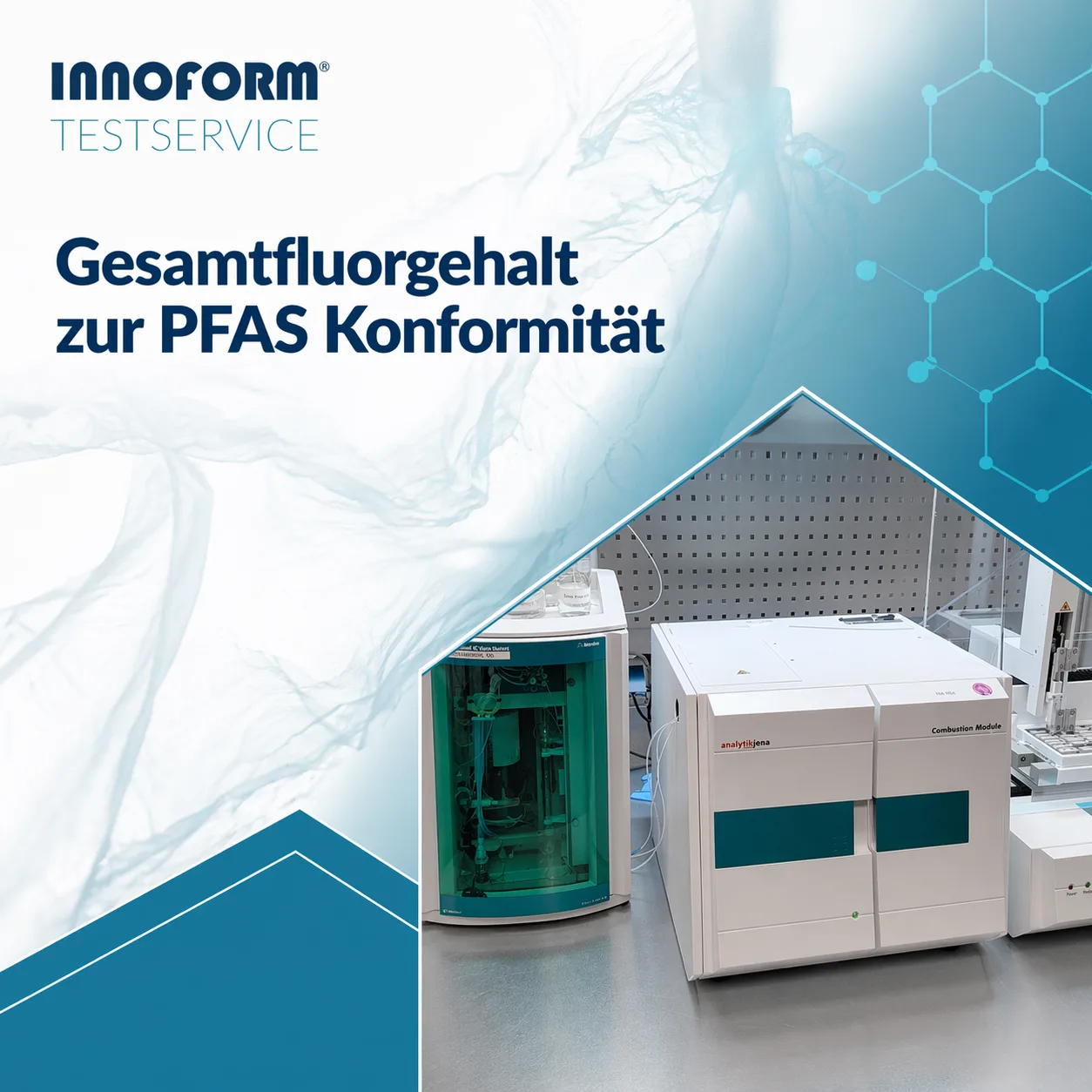
A central approach is the determination of total fluorine content (Total Fluorine, TF).
This enables:
- a quick assessment of potential PFAS contents
- prioritization of materials
- targeted selection of further tests
The method is based on combustion of the sample followed by determination of fluorine content.
Advantage
- Detection of all fluorine-containing components
- independent of known individual substances
- suitable as a screening method
Limitation
- no direct statement about individual PFAS
- further analytical steps required
Differentiation: Where is the Relevant Fluorine?
For more precise assessment, total fluorine content is further differentiated into:
- inorganic fluorine (TIF)
- organic fluorine (TOF)
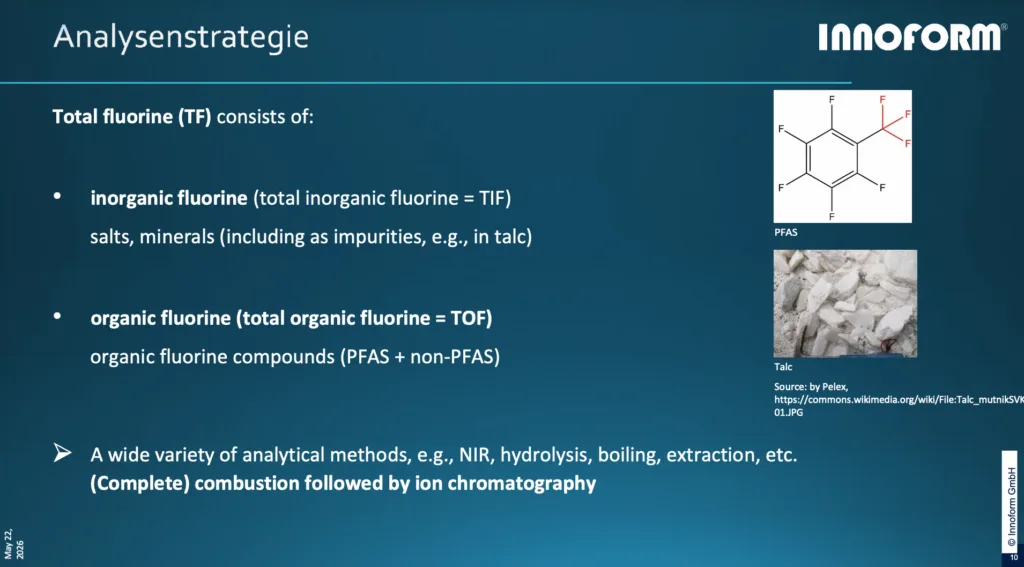
The organic fluorine fraction is particularly relevant, as this is where possible PFAS are contained. This is derived from the difference between total fluorine and inorganic fluorine.
The procedure requires:
- reproducible measurement conditions
- coordinated temperature control
- experience in interpretation
Limitations of Current Methodology
The methods discussed in the regulatory environment are not suitable without restrictions.
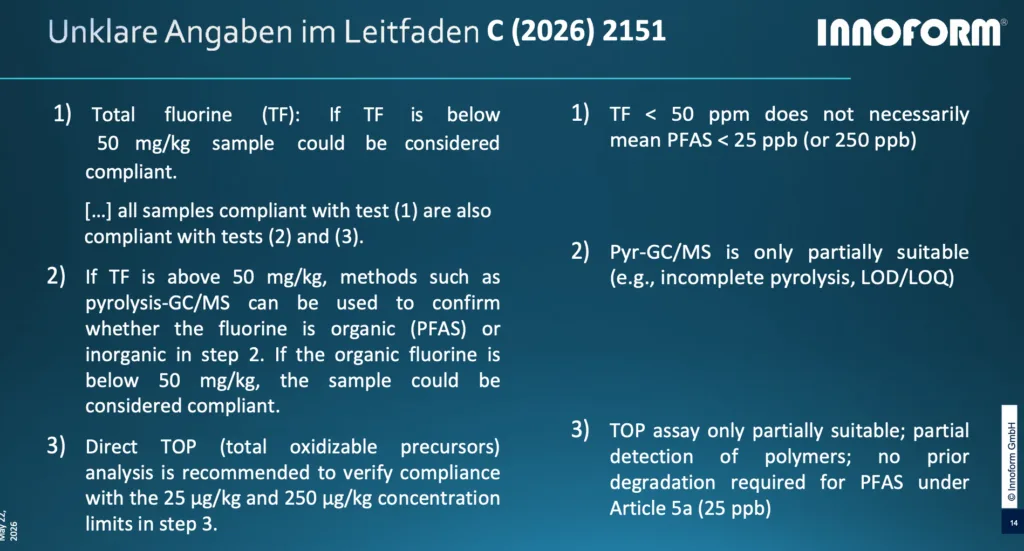
In particular, limitations become apparent with:
- incomplete implementations of individual procedures
- methodological differences between guidelines and practical implementation
Analytics therefore primarily delivers one thing:
reliable guidance, but not yet complete standardization.
Practical Question from the Inno-Talk
A frequently asked question from the Inno-Talk was:
Must testing be performed if no PFAS are intentionally used?
The answer is clear:
- What matters is the PFAS content in the material
- the origin of the substance is of secondary regulatory importance
Even unintentional entries from raw materials, additives or processes must be taken into account.
Innoform Testservice: Extended Capacity for PFAS Analyses
To meet the increasing requirements, Innoform Testservice has expanded its capacity.
We can currently:
- perform total fluorine determinations routinely
- offer differentiations between inorganic and organic fluorine
- systematically assess materials for PFAS risks
- process larger sample volumes at short notice
This enables us to provide the necessary analytical capacity to give companies well-founded guidance on the PFAS content of their packaging.
Inno-Talk Available as Recording
The content of this article is based on the Inno-Talk on PFAS analytics with Dr. Tim Schlüter.
The recording is still available and offers:
- detailed insights into the test methods
- practical examples
- answers to typical questions from the industry
Conclusion
The regulatory requirements are defined, the analytical standards are still developing.
For companies, this means:
- proceed systematically
- understand risks
- use analytics in a targeted manner
Total fluorine determination offers a practical entry point for this.
With its expanded capacity, Innoform Testservice supports
reliably assessing PFAS in flexible packaging and making well-founded decisions.