
Kategorie: Uncategorized

  • Specifications – Much More Than Just Necessary Paperwork

    Specifications – Much More Than Just Necessary Paperwork

    Specifications often seem like time-consuming bureaucracy – yet they are indispensable for quality, efficiency and legal certainty. Packaging specifications, for example, are crucial for the protection of products. This article uses illustrative practical examples to show why well-considered specifications not only ensure quality and clarity, but also reduce economic risks and, in emergencies, can even protect against personal liability.

    Specifications vs. Data Sheets

    At first glance, specifications often seem like a bureaucratic evil, but packaging specifications can reduce this complexity: extensive, complex and time-consuming. In fact, however, they are essential for sustainable quality assurance and economic success in almost every production process – especially in the field of packaging. Their careful preparation is by no means pure bureaucracy, but rather an investment in long-term quality assurance, clarity and efficiency.

    But why is it so important to clearly distinguish between packaging specifications and simple data sheets? Data sheets generally serve only for quick information, often contain target values and deliberately omit binding tolerances. They provide initial information about a product and are usually influenced by marketing departments – informative, but not legally binding. Specifications, on the other hand, contain binding requirements with clearly defined tolerances, standards and test methods. These details ensure clear communication between customers, suppliers and internal departments.

    Consequences of Unclear Document Types

    In practice, it regularly becomes apparent that a lack of clarity between data sheets and specifications can lead to significant problems. In numerous audits, the mixing of these document types leads to deviations and even to serious, so-called “major deviations”. The result is unnecessary costs, considerable additional effort and potential damage to the company’s image.

    The advantages of clear specifications are not only evident in audit situations, but particularly in daily operations. Packaging specifications reduce misunderstandings, minimize complaints and sustainably strengthen customer-supplier relationships. The initial time investment in their creation therefore typically pays off quickly through lower consequential costs.

    Practical Example: Color Change in Expanded Clay Packaging

    An impressive example from practice underscores the benefits of clear specifications: A few years ago, a company changed the printing ink for packaging of expanded clay products. Although the new printing ink initially showed advantages in the processing, products stored outdoors experienced unexpected and significant color changes. Thanks to a precise specification, however, the problem was quickly identified and a pragmatic solution was found together with the customer. Instead of expensive complaints or the destruction of entire batches, the goods were sold with a price discount for indoor storage – a classic win-win situation for both sides. Without packaging specifications, such a quick and clear solution would have been virtually impossible.

    Legal Protection Through Specifications

    However, specifications not only serve practical purposes, they also provide crucial legal protection. A dramatic example illustrates this: A manufacturer of baby food used packaging that did not meet the specified requirements in one batch, which led to serious product failures. Although it ultimately turned out that no serious consequences had occurred, quality managers were personally prosecuted and even charged. Thanks to the existing specification, which was clear and unambiguous, those responsible were able to prove that they had fulfilled their duty of care and emerged unscathed. Without this specification, personal liability might have turned out to be more dramatic.

    Specifications as a Dynamic Quality Instrument

    Another aspect that speaks in favor of packaging specifications is their role as a dynamic quality instrument. We do not treat specifications as static documents, but review and adapt them regularly. When production processes change, new raw materials are added or new regulatory requirements apply, we take this into account immediately – this is how we continuously develop and improve our specifications.

    The definition of realistic and sufficiently broad tolerances plays an important role here. A well-chosen tolerance limit takes real production fluctuations into account without compromising quality. If we set tolerances too narrow, we unnecessarily create waste and drive up costs, while tolerances that are too wide endanger product safety. Precise knowledge of production processes is essential here to establish economically and qualitatively sensible limits.

    Conclusion and Outlook

    In summary, it can be stated that: Packaging specifications are not a troublesome burden, but a central foundation of successful, sustainable business relationships. They not only ensure quality, but also provide legal protection and help avoid costly disputes. Those who understand specifications not just as a mandatory exercise, but as an essential tool for quality assurance, ultimately also increase the efficiency and profitability of their company.

    Training offerings can be found here: innoform-coaching.de/themen/folienpruefung-spezifikation-normen-co

    Your contact person in our test service regarding specifications is Matthias Böhne: 0441 94986-11

  • Precise Material Analysis of (Composite) Films

    Precise Material Analysis of (Composite) Films

    Dr. Daniel Wachtendorf 
     
    The material characterization of films plays a crucial role in research and industry, particularly in the development and quality assurance of packaging materials, technical films and composite materials. Various proven methods are used to precisely analyze the structure, composition and thermal properties of these materials. 

    The precise analysis of composite films is essential to understand their structure and properties. They are often used to clarify the following questions:

    1. Material information: How is the film structured? This question is particularly relevant when the material is unknown – for example, to assess recyclability. 
    1. Avoid confusion: Does the delivered film actually correspond to the ordered specification? 
    1. Error detection in the formulation: Is there a deviation or mix-up in the composition? 
    1. Competitive analysis: Which film variants exist on the market – including those from competitors – for specific applications? 

    The Innoform Testservice in Oldenburg offers a comprehensive analysis package for precise determination of film structure and material composition. This includes microtome cross-sections, DSC (Differential Scanning Calorimetry), polarization thermomicroscopy and infrared (IR) spectroscopy. With these methods, well-founded findings can be obtained that are indispensable for quality assurance, product development and market analyses. 

    The first step in analysis 

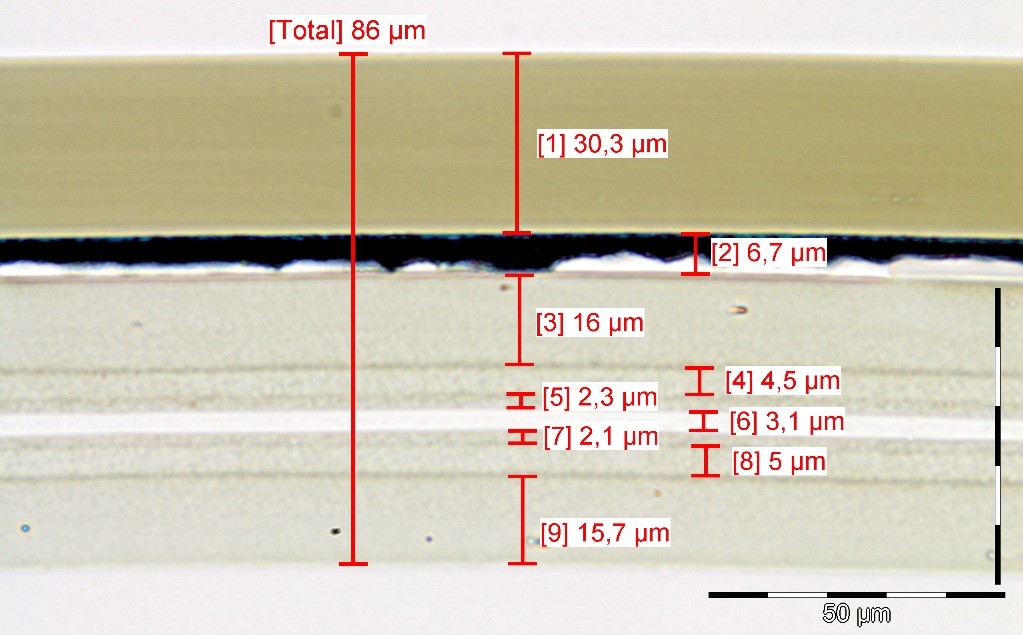
    When the customer sample is received, we first create a quick microtome cross-section. This provides an initial overview of the complexity of the sample and serves as a basis for planning further investigations. After we have determined the required analysis effort, we prepare a detailed microtome cross-section and usually examine it under high magnification in transmitted light. This method allows the number of layers, their thicknesses and basic structure to be determined exactly.

    The microtome cross-section of a film 

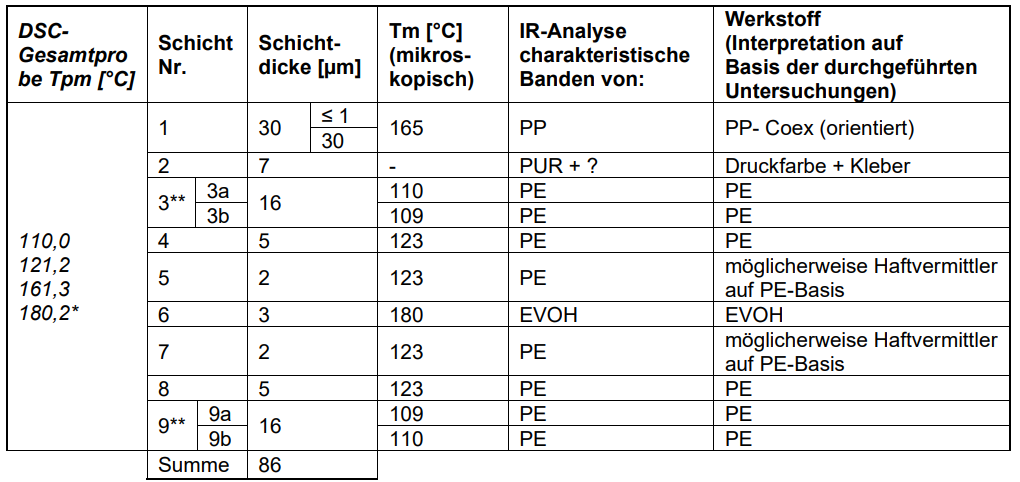
    The images created serve not only as guidance for further analyses, but also for clear visualization for the client. Modern microscopes deliver excellent results and are an essential prerequisite for subsequent material characterization. The microtome cross-section thus forms a central component of the analysis and, together with the tabular summary of results, represents the centerpiece of our reports. 

    Thermal Analysis 

    The second step is Differential Scanning Calorimetry (DSC), a precise method for thermal analysis of the sample. However, before beginning this investigation, halogens must be excluded. This is done using the Beilstein test, a simple chemical detection method for halogens such as PVC or PVDC. We use the property that halogens produce characteristic green flame colorations in the presence of copper. If the film contains halogens, we subsequently forgo DSC analysis to protect the sensor from the resulting gases.

    If the Beilstein test is negative, a thermogram of the sample is created. This provides important thermal parameters such as melting temperatures, melting enthalpies (energy absorption or release) as well as crystallinity and glass transition temperatures. Although DSC does not provide layer-specific results, it offers a comprehensive overview of the thermal properties of the entire sample. Particularly in combination with hot stage microscopy, typical materials such as polyethylene (PE) can be precisely identified. 

    Analysis of the Melting Behavior of Individual Layers 

    Another important step in material characterization is hot stage microscopy. This enables detailed investigation of the melting behavior of individual layers of composite films. After preparing a microtome cross-section, the sample is positioned without medium on a glass slide in the transmitted light microscope. There it is gradually heated in a kind of “mini-oven” and continuously observed. 

    Special polarization filters create a dark field in which semi-crystalline layers become visible as bright areas. Through controlled temperature increase, the melting ranges can be precisely determined. When the melting point is reached, the birefringence disappears, causing the previously bright layers to appear dark. This method allows the thermal properties of individual layers to be accurately determined – even with colored layers, for example with TiO₂, which present a particular challenge. 

    Chemical Analysis of Composition 

    To complement the thermal analyses, infrared (IR) spectroscopy is used. This method provides detailed chemical information about the composition of the individual layers. First, the outer layers of the sample are examined using ATR (attenuated total reflectance) spectroscopy. We then prepare a microtome cross-section and place it in a specially developed stainless steel holder for transmitted light measurement.

    Using an infrared spectrometer, spectra of the individual layers can be recorded and compared with reference spectra. This investigation complements the thermal analyses and serves as a second verification of the results. 

    The intermediate layers of a sample can also be analyzed using the IR microscope, resulting in a complete and detailed structure of the composite film. 

    Summary of investigation results of a film

    Conclusion: Comprehensive Characterization Through Combined Analyses 

    Through the combination of mechanical, thermal and chemical analyses, the analysis package from Innoform Testservice offers an opportunity to characterize films in detail. From the first microtome cross-section to the final IR spectroscopy, a comprehensive picture of the material structure and composition emerges. This precise approach not only provides valuable insights for technical and industrial applications, but also sets a high standard in modern film characterization.