
When food, pharmaceutical, or cosmetics packaging on retail shelves suddenly “draws air,” the protective gas escapes, liquids leak out, or the product spoils long before the best-before date (BBD) is reached, the big search for the cause usually begins. Frequently, initial suspicion immediately falls on the barrier of the film: “The oxygen barrier is not sufficient!” However, after more than 30 years of laboratory practice at Innoform Testservice and countless damage analyses, I can assure you: In the vast majority of cases, it is not the film web that is the problem – but the heat seal.
Around 90% of all flexible consumer packaging today is thermally sealed using heat contact processes. The heat seal is the structural Achilles’ heel of any flexible packaging. Exactly there, material properties, machine settings, tool geometries, and the product to be filled meet within fractions of a second. In this detailed technical article, based on scientific market studies (including those by the OFI in Vienna and Fraunhofer IVV / IVLV), our seminar documents, and our accredited testing practice, I will show you how many film packagings actually suffer from sealing problems, why tiny capillaries destroy any high barrier, and how you can reliably avoid typical leaks through clever testing and sound know-how.
How Many Film Packagings Leak Due to Sealing Problems? A Look at the OFI Study and the Market
In our seminars, I like to start by asking the provocative question: “What percentage of modified atmosphere or vacuum packaging on supermarket shelves do you think is actually not as tight as the brand owner believes?” The answers from participants usually range from a cautious 0.1 to 0.5 percent – after all, modern packaging lines are highly automated. However, scientific data paints a significantly more unvarnished picture.
The Well-Known Market Study by OFI in Vienna
Particularly insightful in this regard is a comprehensive study by the Austrian Research Institute for Chemistry and Technology (OFI) in Vienna (led by Dr. Michael Washüttl, Prof. Manfred Tacker, and Birgit Tauschitz). OFI examined a total of over 1,600 food products packaged under modified atmosphere (MAP – Modified Atmosphere Packaging) from regular retail in the DACH region – including meat and sausage products, cheese, fish, baked goods, and convenience products. In addition, a specific sample of 386 MAP packagings in German retail was examined in detail.
The result caused a stir throughout the entire packaging industry:
- Only 56% of all examined MAP packages in retail exhibited an optimal protective gas atmosphere.
- approx. 33% up to 44% of the packages – and in the German retail sample even almost 50% – showed significant deficiencies in the gas mixture or did not fulfill their purpose of extending shelf life as intended.
- As main causes, alongside an incorrectly designed film barrier and interactions between the filled product and test gas, the Viennese researchers primarily identified leaks due to defective heat seals: unsuitable sealing tools, misadjusted or incorrectly displaying temperature sensors on the sealing jaws, mechanical overstressing during packaging, as well as product contamination in the seal area.
Supplementary Studies by WRAP and IVLV / Fraunhofer IVV
These findings line up seamlessly with further international surveys. A widely cited British study by the organization WRAP (“Seal integrity and the impact on food waste”, Dudbridge & Turner) as well as the IVLV Guideline No. 114 from the research project EVOCOSEAL (Fraunhofer IVV in cooperation with the Universities of Hasselt and KU Leuven) impressively show:
- In 58% of all cases of defective packaging, contamination of the heat seal (by product splashes, fats, dusts, or condensate) is the primary cause of package failure.
- Depending on film type and contamination, heat seal strength can drop by up to 88% due to product residues in the seal area.
Even though these studies were conducted some years ago, the trend remains unbroken today. Sealing problems are still the main cause of leaks in flexible packaging today.
My Practical Estimate: How Many Packages Are Really Affected Today?
Naturally, inline quality control has evolved since the first OFI surveys. Obvious “bursts” or completely open seals that are immediately noticed on the filling line usually range between 0.1 and 1% in well-managed operations. But that is only half the truth – because a large portion of critical leaks consists of micro-leaks (capillaries with diameters of 10 to 50 µm) in the fold transition or a pre-damaged hot tack, which often remains undetected during a quick spot check in a water bath or only opens during transport due to pressure and vibration stress.
When we combine the findings of OFI Vienna, Fraunhofer/IVLV research, and our ongoing laboratory tests at Innoform Testservice, my realistic estimate for today’s market is:
- 70 to 80% of all real packaging leaks do not occur in the undamaged film area, but directly in or immediately adjacent to the heat seal (seal edges, gussets, 2-/4-layer transitions).
- Across all flexible film packagings on the market, an estimated 3 to 8% of all packages exhibit avoidable heat seal weak points or micro-leaks.
- For sensitive MAP packaging, vacuum packaging, liquid and powder products, as well as lines newly converted to mono-materials or paper laminates, the rate of non-optimally sealed joints in practice is often even 5 to 15%.
“Barrier begins where tightness ends. Before philosophizing about permeation, everything must first be leak-tight.”
Barrier vs. Tightness: Why a Single 25 µm Hole Renders Any High-Barrier Film Packaging Useless
To understand why even the smallest sealing defects have such dramatic consequences for product protection, it is worth looking at a simple calculation example that I regularly present in our seminar “Leakage testing, sealing and processing of barrier film packaging (Barrier Films Part 4)”.
Imagine a classic high-barrier pouch with a surface area of 375 cm², made from a metallized laminate (PET-BO met. 12 µm / PE 90 µm). The oxygen transmission rate (OTR) of this intact barrier film is an excellent 0.3 cm³/(m² · d · bar):
- Oxygen ingress through permeation (intact film area): Across the entire pouch surface of 375 cm², under a pure oxygen gradient, only 0.011 cm³ of oxygen per day and package diffuses through the material.
- Oxygen ingress through a single micro-leak in the heat seal: Now let us assume that in the 10 mm wide heat seal there is a single continuous capillary (“cannula”) with a diameter of only 25 µm (half as thin as a human hair!) due to a tiny fold or dust particle. Through this single micro-channel alone, around 0.052 cm³ of gas flows into the package per day.
In plain English, this means: A single 25 µm capillary in the heat seal allows almost five times as much oxygen into the packaging as the entire high-barrier film combined! And if the pore diameter is 50 µm, the gas ingress multiplies drastically once again. So anyone spending a lot of money on EVOH, SiOx, AlOx, or aluminum barriers without having their heat seals under control is throwing money out the window.
“How Tight Is Tight?” – Typical Defect Points and Leak Rates
Absolute leak tightness in a physical sense does not exist – what matters is always which defect size becomes critical for your specific product. The following overview (based on guide values from the Fraunhofer Institute IVV and leak testing technology) helps with practical categorization:
| Everyday requirement | Critical pore size / capillary diameter | Typical leak rate (guide value) | Practical example & risk |
|---|---|---|---|
| Sifting-proof / Insect-proof | approx. 100 – 200 µm | > 10⁻¹ mbar·l/s | Sugar, flour, rice; protection against stored product pests |
| Dust-proof | approx. 25 – 30 µm | approx. 10⁻¹ to 10⁻² mbar·l/s | Fine powders, spices, cocoa powder |
| Water vapor-tight | approx. 20 – 25 µm | approx. 10⁻² mbar·l/s | Dry products, crackers, milk powder clumping |
| Liquid-tight (droplets) | approx. 15 – 20 µm | approx. 10⁻² mbar·l/s | Soups, sauces, pet food, wet wipes |
| Vapor-tight (“sweating”) | approx. 10 – 15 µm | approx. 10⁻³ mbar·l/s | Loss of aroma, drying out during storage |
| Gas-tight & bacteria-proof | approx. 5 – 10 µm | approx. 10⁻⁴ mbar·l/s | MAP packages, vacuum packaging, medical devices |
The 5 typical causes of leaking heat seals – and how to avoid them
When customers from the food, pharmaceutical, or consumer goods industries send rejected pouches or trays to our Oldenburg laboratory, we repeatedly encounter five recurring failure patterns in failure analysis. The good news: every single one of these problems can be reliably eliminated with the right material selection and targeted testing.
1. Contamination in the sealing area (“Sealing through contamination”)
When filling pouches and trays, cocoa powder, ground coffee, milk powder, or grated cheese swirl up; with wet products, marinades, fats, cooking oils, or condensation splash onto the sealing rim. If this product gets between the sealing jaws, it acts as a release layer and prevents the interdiffusion (entanglement) of the molten polymer chains.
How to avoid this error: In addition to optimized product dosing and extraction, the sealing medium is key here. While simple standard PE-LD or BOPP quickly reaches its limits when contaminated, low-melting metallocene polyethylenes (mLLDPE), ethylene copolymers (such as EVA), or ionomers (known, for example, as Surlyn®) can flow around dust particles and extremely fine grease films much better due to their low melt viscosity and still seal tightly.
2. The critical 2-to-4-layer step (side gussets, overlaps, and gusset transitions)
Take a close look at a typical flowpack or stand-up pouch (Doypack): where the longitudinal seal (fin seal) or the side gusset runs into the cross seal, the material thickness abruptly jumps from two layers to four layers. Exactly at this edge, a small wedge-shaped cavity is formed – the so-called gusset transition (“Zwickel”).
If the sealing layer is designed too thin (e.g., only a few micrometers of heat-sealable coex-PP) or if the sealing jaws are rigid and incorrectly profiled, the molten polymer volume is simply insufficient to “flood” this step. A continuous capillary channel of 20 to 100 µm remains open.
How to avoid this error: The thickness and flowability of the sealing layer must always be matched to the total thickness of the laminate and the step height. Using a microtome section under a light microscope combined with a dye penetration test according to DIN 55508-2, we can visualize in the laboratory within a very short time whether the gusset area is filled cleanly or whether polymer mass is missing.
3. Insufficient hot tack strength (hot tack failure)
On high-speed vertical form-fill-seal machines (VFFS), the following happens: the cross jaws seal the bottom seam, open, and just milliseconds later, the heavy filling product (e.g., 500 g of nuts, frozen vegetables, or washing powder) drops from the filling tube directly into the still hot, molten heat seal. At the same time, the film draw-down pulls on the seam.
If the sealing layer has a weak hot tack (hot seal strength) in this hot temperature window, the melt is partially pulled apart. Fine threads, micro-caverns, or local cracks form. The tricky part: when you test the cooled pouch later in a standard tensile test, the seam still appears strong – but due to the micro-channels formed while hot, the pouch is already leaking!
How to avoid this error: For fast FFS processes, never rely solely on cold heat seal strength. Have a complete hot tack curve recorded according to DIN 55571-2 or ASTM F 1921. It shows exactly at which sealing temperature the material offers the highest resistance in the hot state.
4. Narrowed sealing windows due to mono-materials and paper laminates (PPWR effect)
In the past, classic composite films such as PET/PE or OPA/PE were extremely forgiving: the outer PET or PA layer melted only beyond 220 to 250 °C, while the inner PE layer sealed starting at 105 °C. Machine operators enjoyed a comfortable sealing window of 30 to 50 °C. If the seal didn’t hold, you simply increased the machine temperature by 15 degrees – and it ran smoothly.
With the European Packaging and Packaging Waste Regulation (PPWR) and the shift towards recyclable all-PE or all-PP mono-materials as well as fiber-based barrier papers with wafer-thin dispersion sealing coatings, this picture has completely changed:
- With polyolefin mono-materials, the melting points of the outer layer (e.g., oriented BOPE or BOPP) and the inner layer (sealing PE or sealing PP) are close together. If sealed too hot, the outer film shrinks, the seam warps, or the liquid polymer is squeezed away at the sealing jaw edge – resulting in a thin spot and a classic seal edge break.
- With paper laminates, the paper acts as a thermal insulator (poor heat transfer), while the internal dispersion coating is often only a few grams per square meter thin and can barely compensate for irregularities in the paper fibers.
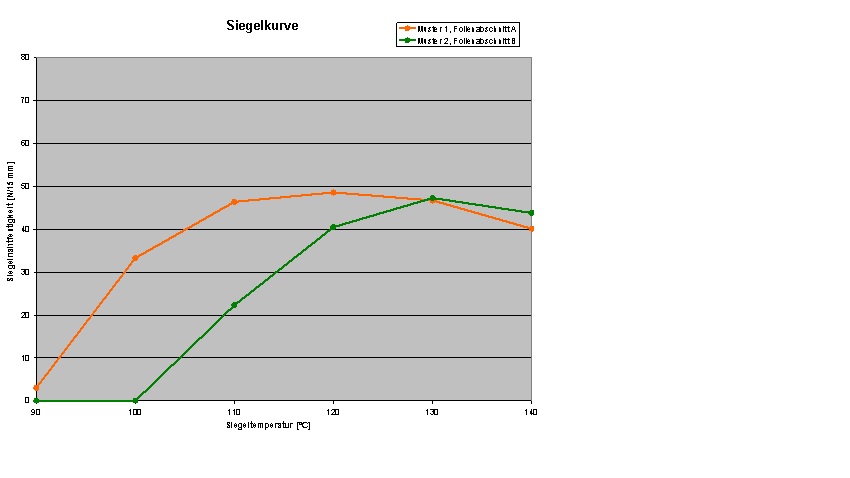
How to avoid this error: As the diagram from one of our sample laboratory reports shows, even a slight formulation change during coextrusion (e.g., a lower proportion of low-melting plastomer in the PE blend) can shift the seal initiation temperature (SIT) upwards by 10 to 15 °C. Combining a laboratory sealing curve (DIN 55529), DSC melting point analysis, and FTIR spectroscopy allows us to determine beyond doubt whether the material deviated or whether the temperature distribution of your sealing jaws needs to be readjusted.
5. The conflict of objectives between seal integrity and easy opening (peel seals)
Consumers want packaging that can be opened smoothly by hand without scissors (easy-peel) – at the same time, quality assurance demands absolute seal integrity throughout the entire logistics process. A widespread misconception is: “A peel seal of 4 N/15 mm is less tight than a solid weld seam of 40 N/15 mm.”
Physically, this is not true: as long as the sealing layer is completely sealed through, a peel seal (whether interfacial peel, cohesive peel via incompatible blends such as polybutene-1, or burst/tear peel) is just as gas-tight and liquid-tight as a permanent weld seam. It only becomes critical when external forces – such as the re-tensioning of a vacuum pack, internal pressure increases during truck transport over an Alpine pass, or impacts in the shipping carton – exceed the initial tear force of the peel seal and the seam partially migrates open.
How to avoid this error: In addition to the pure tensile strength of strip samples, also test the actual opening forces on the complete package in accordance with DIN 55409-1 (flexible packaging materials) or DIN 55409-2 (rigid trays) and specifically adapt the sealing jaw contour (e.g. round profile for smooth initiation) to your peel system.
Testing correctly at Innoform Testservice: Systematically securing heat seal strength and seal integrity
In our testing laboratory in Oldenburg, accredited according to DIN EN ISO/IEC 17025 (DAkkS), we strictly distinguish between two complementary testing pillars: mechanical seal strength tests (How high is the holding force and how wide is the process window?) and physical seal integrity / leak tests (Are there continuous channels or pores?). Both aspects are inextricably linked for a clean packaging specification.
Pillar 1: Testing heat seal strength, seal curves, and hot tack
During the mechanical testing of heat seals, a sample strip exactly 15 mm wide is punched out perpendicular to the seal seam and pulled apart in a tensile testing machine at a defined speed. But beware: anyone looking only at the bare numerical value in N/15 mm in the test report often overlooks the most important thing!
“Force values alone are not enough – the failure mode tells the truth.”
That is why at Innoform we always document the failure mode / fracture pattern for every heat seal strength measurement:
- Clean peeling (separation of the seal layer): Desirable for easy-opening packaging; in the case of permanent seals, however, it indicates a sealing temperature that is too low (cold seal).
- Break directly at the seal edge (seal edge break): A typical sign of excessively high sealing temperature or sealing pressure – the sealing layer was squeezed and weakened at the jaw edge.
- Laminate delamination: The seal seam holds stronger than the lamination between the individual layers – the film splits within the laminate (indication of insufficient interlayer adhesion or an unsuitable laminating adhesive).
- Elongation / break in the unsealed film strip: The seal seam is stronger than the base material itself (true weld seal).
| Test method at Innoform Testservice | Standard / Basis | Measured parameter & temperature range | Typical practical benefit |
|---|---|---|---|
| Heat seal strength (strip tensile test) | DIN 55529, ASTM F 88 / F 88M, DIN EN 868-5 App. D | Maximum force / profile in N/15 mm (-40 °C to +120 °C) incl. failure mode | Quality control of manufactured pouches, medical packaging & trays; testing under deep-freeze or pasteurisation conditions |
| Seal curves on the laboratory heat sealer | DIN 55529, ASTM F 88 | Heat seal strength over temperature, time & pressure (e.g. 80 – 220 °C) | Determination of seal initiation temperature (SIT) and optimal sealing window; comparison of new mono-materials with reference films |
| Hot tack testing (hot seal strength) | DIN 55571-2, ASTM F 1921 | Maximum holding force of the still hot seal in N/15 mm directly after jaw opening | Essential for fast v-FFS and h-FFS form-fill-seal machines as well as heavy, bulk or deep-frozen products |
| Opening forces of peelable packages | DIN 55409-1 (flexible), DIN 55409-2 (rigid) | Tear initiation force and propagation force in N on the original package | Practical evaluation of opening behavior (easy opening) from a consumer perspective |
| Seal quality of PE heavy-duty bags & paper | DIN 55529, GKV Test Sheets I–IV, DIN EN 868-4 | Seal strength, fiber tear & seal quality | Securing heavy-duty bags, industrial pouches, and sterilizable paper-film packaging |
Pillar 2: Overview of seal integrity testing and leak detection
A high heat seal strength in the strip tensile test does not prove that no microscopic capillary has remained open in the 2-/4-layer gusset. Therefore, we combine strength testing in our test portfolio for heat seal strength & seal integrity with targeted leak detection and seal integrity testing:
| Seal integrity / leak test method | Standard / Test specification | Detection limit (approx.) | Working principle & ideal field of application |
|---|---|---|---|
| Test gas method (forming gas N₂/H₂) | IVLV Guideline No. 102 | < 10 µm (gas-tight) | Filling with a hydrogen-nitrogen mixture and highly sensitive H₂ sniffer probe; non-destructive localization of minute gas leaks on MAP and vacuum packaging |
| Dye penetration test with methylene blue | DIN 55508-2 | approx. 10 – 20 µm | Alcohol solution with low surface tension creeps even into the finest seal capillaries and gussets, staining defects in contrasting blue |
| Dye penetration testing (Rhodamine B / aqueous) | ASTM F 1929 | approx. 15 – 50 µm | International standard (esp. pharma/medical) for detecting channels in transparent and opaque heat seals |
| Penetrating oil test & original product testing | In-house method PV036 | approx. 10 – 20 µm | Special test for oil- and fat-containing products as well as for detecting micro-pinholes after flex-cracking strain (Gelboflex) |
| Vacuum chamber / water bath (bubble emission test) | Standard laboratory method (DIN EN ISO 11607 / ASTM D 3078) | approx. 15 – 30 µm | Submerging the closed package under defined vacuum; escaping gas bubbles immediately reveal the exact location of the leak |
| Light table & copper deposition | DIN EN 546-4, FhG Leaflet 29 Sheet 1 | from 20 µm (optical) or micro-pinholes | Testing aluminium foils and aluminium laminates for pinholes, flex cracks, and corrosion defects |
Practical checklist: How to permanently eliminate complaints caused by poor heat seals
From our daily consulting practice, five specific rules have proven effective in helping film manufacturers, converters, and packers drastically reduce their defect rates:
- Specify performance instead of just film thickness: Include the seal initiation temperature (SIT), the sealing window in °C, the required heat seal strength in
N/15 mm(incl. desired failure mode!), and, for fast form-fill-seal processes, the minimum hot tack bindingly in your film specification. - Systematically store retained samples: Set aside an unprinted or unsealed retained sample from a film batch proven to run perfectly. If machine malfunctions occur later, a direct comparison between good and bad samples in the laboratory can clarify within a few days what has changed.
- Test in the laboratory before switching to mono-materials: Do not go “flying blind” onto the production line with new all-PE, all-PP, or paper laminates. A seal and hot tack curve recorded in advance in the laboratory saves expensive machine downtime and tonnes of scrap.
- Regularly inspect sealing jaws thermographically and mechanically: As the OFI study showed, the digital display on the control cabinet often does not match the actual surface temperature of the sealing jaw. Check temperature profiles and pressure distribution (e.g. via carbon paper or pressure-sensitive film impressions) regularly, especially in the area of the 2-/4-layer step-down.
- Test seal integrity using the correct method: A brief press on the pouch by hand or an unspecific water bath test is often insufficient for MAP and high-barrier packages. For critical products, use the dye penetration test according to DIN 55508-2 or the test gas method according to IVLV Guideline 102.
Knowledge protects against failure costs: Our matching Innoform seminars
Good test results only unfold their full value when procurement, quality assurance, packaging development, and machine operators speak the same technical language. If you and your team would like to dive deeper into the interrelationships between polymer structure, sealing technology, and testing methodology, I recommend our practical web seminars and courses at Innoform Coaching:
- Leakage testing, sealing and processing of barrier film packaging – Barrier films Part 4 (BVd): Our specialized seminar covering the difference between leak tightness and permeation, contamination in the seal area, peel systems and modern leak testing methods.
- Fundamentals of packaging films – Part G (Sealing layers & sealing properties of PE and PP) as well as Part C (Describing film properties with test results): How raw material density, melt flow rate (MFR), coextrusion and test standards control runnability on machines.
- Mechanical film testing – The tensile test (with live demonstrations from the laboratory): Everything about sample preparation, grips/clamps, heat seal strength, laminate adhesion and fracture pattern analysis.
- Packaging in flexible packaging (FFS systems & modified atmosphere packaging MAP): The direct interaction of film, former shoulder, sealing tools and protective gas directly on the packaging machine.
Frequently asked questions on heat seal strength and leak testing (FAQ)
Why is packaging sometimes leaky despite high heat seal strength in N/15 mm?
Heat seal strength according to DIN 55529 or ASTM F 88 measures the mechanical holding force on a 15 mm wide strip of the cooled seal. However, leaks often occur locally – for example due to a fine capillary (10–30 µm) at the 2-to-4-layer transition (side gusset/fold), individual product particles in the seal, or a brief opening of the still hot seal due to insufficient hot tack strength. Therefore, strength testing should always be supplemented by targeted leak testing (e.g., methylene blue test according to DIN 55508-2 or test gas testing).
According to studies, how many modified atmosphere packages (MAP) on the market are defective?
In the well-known market study by the Austrian Research Institute for Chemistry and Technology (OFI) in Vienna analyzing over 1,600 MAP packages in German-speaking countries, only 56% exhibited an optimal protective gas atmosphere; around one third to 44% (and nearly 50% in a German retail sample of 386 packages) showed defects. Supplementary studies (WRAP, Fraunhofer IVV / IVLV Leaflet 114) demonstrate that in 58% of defective package cases, a contaminated seal is the primary cause. In current practice, it can be assumed that 70 to 80% of all real packaging leaks occur in or directly at the heat seal.
Which test method detects even the smallest micro-leaks in heat seals?
For directly visualizing the finest channels in the heat seal down to approx. 10–20 µm, dye penetration testing with methylene blue solution according to DIN 55508-2 (or ASTM F 1929 with aqueous dye solution) is ideal. If closed packages need to be non-destructively tested for gas tightness (flaws < 10 µm), the test gas method using forming gas (hydrogen/nitrogen) and a sensitive hydrogen probe according to IVLV Leaflet No. 102 is the method of choice.
When should a hot tack test be conducted in addition to the seal curve?
A hot tack test according to DIN 55571-2 or ASTM F 1921 is indispensable whenever the heat seal is subjected to mechanical stress while still hot and incompletely cooled. This applies above all to high-speed vertical and horizontal form-fill-seal machines (v-FFS / h-FFS), heavy or sharp-edged filled goods, and the transition from classic PET/PE laminates to mono-materials (PE, PP) or barrier papers.
My Conclusion: In case of damage, let analytics do the talking!
Leaky packages are not an inevitable fate – and certainly no reason for weeks of playing the blame game between film supplier and packager. Whether a seal fails due to product contamination, a narrow sealing window with a new mono-material, insufficient hot tack, or an open gusset at the 2-to-4-layer transition can now be clarified in the lab quickly, objectively, and in compliance with standards.
My practical advice is therefore: Specifying is better than philosophizing. And if things get stuck on the line or packages leak air in retail: don’t just blindly adjust the sealing temperature, but send us your good and defective samples to our laboratory in Oldenburg. We test heat seal strength and leak tightness accredited from a single source and provide you with results that allow you to operate safely in production again right away.
Yours, Karsten Schröder
Innoform Testservice – Your accredited testing laboratory for flexible packaging
References, Standards and Further Reading
- Washüttl, M.; Tacker, M.; Tauschitz, B. (OFI – Austrian Research Institute for Chemistry and Technology, Vienna): Market study on the quality and seal integrity of over 1,600 food products packaged under modified atmosphere (MAP) in retail across the DACH region (incl. a subsample of 386 MAP packages in German retail).
- Dudbridge, M.; Turner, R. (WRAP – Waste & Resources Action Programme, Banbury / University of Lincoln): Seal integrity and the impact on food waste, Project Code RBC521-001.
- Industrievereinigung für Lebensmitteltechnologie und Verpackung e. V. (IVLV) / Fraunhofer IVV, Freising / UHasselt / KU Leuven: IVLV Code of Practice No. 114 – Prevention of heat seal defects caused by contamination in the sealing area (CORNET Research Project EVOCOSEAL), as well as IVLV Code of Practice No. 102 – Tightness testing of flexible food packaging using test gas methods.
- DIN 55529: Packaging – Determining the sealed-seam strength of sealings made of flexible packaging material; ASTM F 88 / F 88M: Standard Test Method for Seal Strength of Flexible Barrier Materials; DIN EN 868-4 & DIN EN 868-5: Packaging for terminally sterilized medical devices.
- DIN 55571-2 & ASTM F 1921 / F 1921M: Standard Test Methods for Hot Seal Strength (Hot Tack) of Thermoplastic Polymers and Blends Comprising the Sealing Surfaces of Flexible Webs; DIN 55409-1 & DIN 55409-2: Packaging – Determination of opening forces of peelable packaging.
- DIN 55508-2: Packaging test – Leak testing on flexible packaging – Part 2: Dye penetration test (methylene blue method); ASTM F 1929: Standard Test Method for Detecting Seal Leaks in Porous Medical Packaging by Dye Penetration; ASTM D 3078: Standard Test Method for Determination of Leaks in Flexible Packaging by Bubble Emission; DIN EN ISO 11607-1.
- Schröder, K. (Innoform Coaching & Innoform GmbH Testservice, Oldenburg): Seminar documentation “Leakage testing, sealing and processing of barrier film packaging – Barrier films Part 4 (BVd)” and “Fundamentals of packaging films (Parts C & G)”.
