
Why impact resistance is an important quality feature and what role it plays in product standards
Plastic films must withstand a wide variety of mechanical stresses in practical use. During processing, packaging, transport, and storage, sudden forces can act on the film. An impact against the packaging or a falling object can be enough to damage a film. Especially with thin films, the question arises as to how resistant the material is to such dynamic stresses.
An established method for examining this property is the dart drop test according to DIN EN ISO 7765-1. It makes it possible to determine the impact resistance of plastic films under defined conditions and to compare different materials with one another. In addition, the method is also applied in product standards.
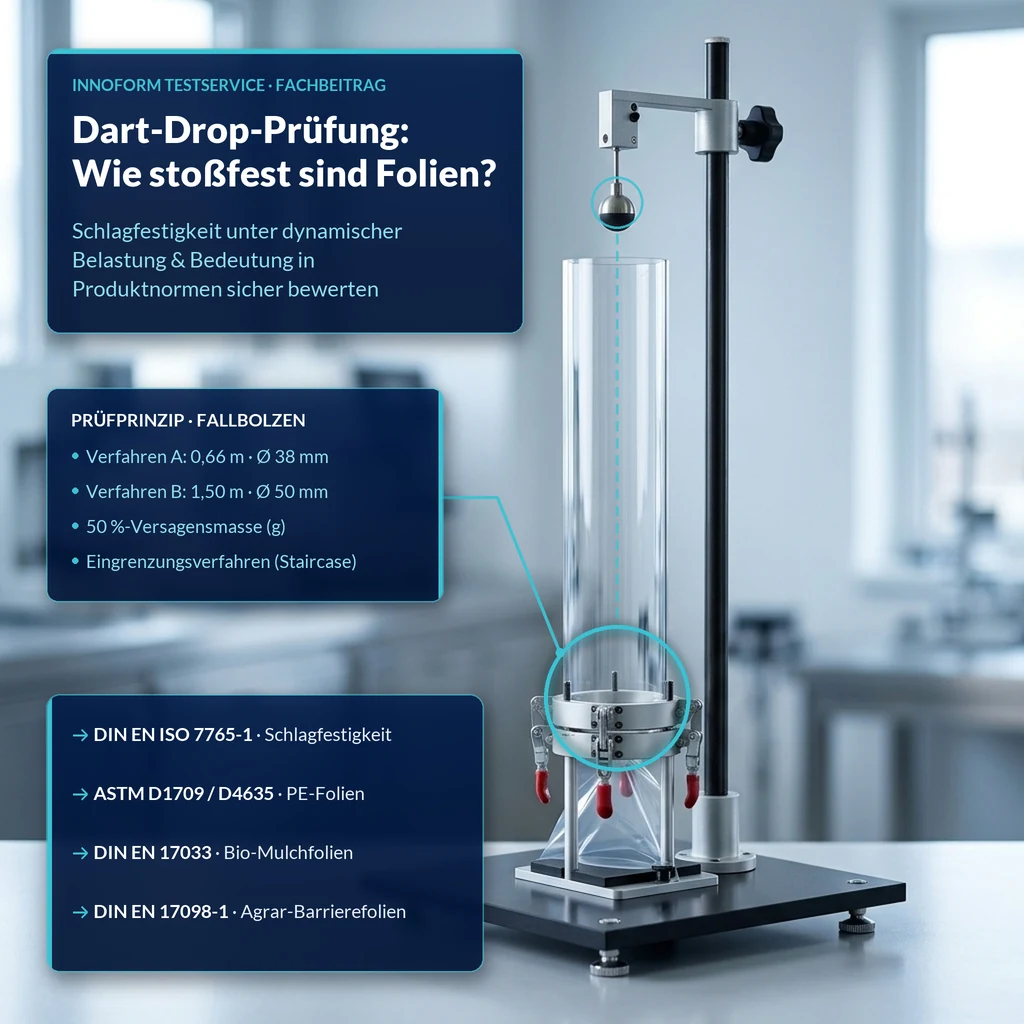
What is measured in the dart drop test?
In the dart drop test, a dart with a hemispherical head is dropped from a specified height onto a clamped film sample. The test examines whether the film withstands or fails under the sudden impact load.
The test is carried out according to DIN EN ISO 7765-1 using the so-called staircase method. Here, the mass of the dart is modified incrementally. After each test, the mass is adjusted depending on whether the sample failed or not.
The result obtained is the dart mass at which statistically 50% of the tested samples fail. This value is usually stated in grams.
The standard distinguishes between two test methods:
- Method A: Drop height 0.66 m, dart diameter 38 mm
- Method B: Drop height 1.50 m, dart diameter 50 mm
The choice of method depends, among other things, on the expected resistance of the film. Results from the two methods must not be compared directly with one another.
A higher dart drop value means that the film withstands greater impact stress under the respective test conditions.
Why is the dart drop test particularly practical?
Many mechanical test methods examine the behavior of a material under a slowly increasing load. These include, for example, tensile tests or quasi-static puncture tests.
In practical applications, however, sudden impact loads frequently occur.
An example is a film bag filled with products hitting an edge during transport. High mechanical stress can also occur briefly during filling, stacking, or handling of packaging.
The dart drop test simulates such dynamic loading under reproducible conditions.
This makes it particularly relevant for evaluating:
- Packaging films made of PE-LD, PE-LLD, and other polymers
- Pouch and sack films
- Transport and protective packaging
- Agricultural films
- Films with increased requirements for mechanical resistance
However, it must be taken into account that the test simulates a defined, localized impact load on a flatly clamped film. The actual behavior of a finished package also depends on its geometry, the heat seals, the contents, and the specific load conditions.
The dart drop test is therefore a practical method for material evaluation, but it does not replace application-specific testing of the finished packaging.
Dart drop as a tool for comparing different films
A particular strength of the dart drop test lies in the direct comparison of different film qualities.
When developing new formulations or switching raw materials, the question frequently arises as to whether a change in material composition affects mechanical durability.
Here, the dart drop test can provide valuable information.
For example, the following questions can be investigated:
- How does impact resistance change when using different PE grades?
- What are the effects of a modified formulation?
- How do films with and without recyclate content differ?
- What influence do processing conditions and film orientation have?
- Can a film maintain sufficient impact resistance when thickness is reduced?
Is a thicker film automatically more impact-resistant?
In principle, film thickness influences impact resistance. However, there is no universally linear relationship between the two parameters.
Therefore, a film that is twice as thick does not necessarily have twice the dart drop value.
In addition to thickness, factors such as polymer structure, material composition, manufacturing conditions, and film orientation influence the result.
For a meaningful material comparison, films of similar thickness should therefore ideally be tested under identical test conditions.
Particularly in the development of thinner packaging films, the dart drop test can help identify potential changes in mechanical strength.
What significance does dart drop have in product standards?
The dart drop test is not exclusively a method for research and development. It is also referenced in various standards for plastic films.
A distinction must be made between a test standard and a product standard.
DIN EN ISO 7765-1 describes how impact resistance is to be determined.
Product standards, on the other hand, can specify which properties certain films must exhibit and which test methods are to be used for their evaluation.
Examples include:
ASTM D4635: PE films for packaging applications
ASTM D4635 describes requirements for low-density polyethylene films (LDPE and LLDPE) for general applications and packaging purposes.
In addition to properties such as tensile strength, friction behavior, and sealability, impact resistance is also considered. The test method used here is ASTM D1709, the American counterpart to the dart drop test.
The standard shows that impact resistance can play an important role when specifying packaging films.
DIN EN 17033: Biodegradable mulch films
Mechanical resistance is also important for agricultural films.
DIN EN 17033 addresses biodegradable mulch films for use in agriculture and horticulture. It contains requirements for various material properties and incorporates impact resistance testing according to DIN EN ISO 7765-1.
DIN EN 17098-1: Barrier films for soil fumigation
For barrier films used in agricultural applications, mechanical requirements must be taken into account in addition to barrier properties.
DIN EN 17098-1 also refers to the testing of impact resistance according to DIN EN ISO 7765-1.
These examples illustrate that the dart drop test is not only used as a comparative laboratory test, but also plays a role in the normative evaluation of certain film products.
Which specific requirements apply depends on the respective product standard, its edition, and the intended field of application. Not every standard listing a test method automatically prescribes a uniform minimum value for all films.
Why is a tensile test alone not sufficient?
Tensile strength and elongation at break are among the most frequently determined mechanical properties of plastic films.
They provide important information about how a material behaves under increasing tensile stress.
In contrast, the dart drop test examines the behavior under rapid, localized impact stress.
Both test methods therefore consider different mechanical properties.
A film with high tensile strength does not necessarily possess particularly high impact resistance. Conversely, a film with comparatively low tensile strength may show favorable behavior under sudden impact stress.
For a comprehensive mechanical characterization of packaging films, it is therefore advisable to combine different test methods with one another.
In addition to the dart drop test, methods such as tensile testing, tear resistance testing, and puncture resistance testing can provide important additional information.
What does this mean for quality assurance?
The dart drop test is particularly suitable for comparative studies and monitoring consistent material properties.
For regularly produced film grades, changes in impact resistance can, for example, provide indications of variations in raw material composition or the manufacturing process.
The test can also be used as part of a comparative material assessment when changing a raw material supplier or implementing new formulations.
What is crucial here is that the test conditions are comparable.
In addition to the selected method, film thickness, sample preparation, and conditioning should be taken into account in particular.
A single dart drop value should therefore not be viewed in isolation. Its significance arises primarily in connection with other material parameters and the requirements of the final application.
Conclusion: A simple test with high practical relevance
The dart drop test provides important information on the resistance of plastic films to sudden mechanical stresses.
Due to the standardized test conditions, different film qualities can be compared in a targeted manner and changes in material properties can be investigated.
Its inclusion in various product standards underlines the importance of impact resistance as a quality feature.
The test is particularly valuable because it investigates a type of stress that can also occur in practical packaging handling.
Anyone wishing to evaluate plastic films with regard to their mechanical performance should therefore not look exclusively at tensile strength and elongation at break. Impact resistance according to the dart drop method provides important complementary information.
Having impact resistance tested at Innoform
Innoform Testservice offers accredited determination of the impact resistance of plastic films according to DIN EN ISO 7765-1.
Whether material comparison, formulation optimization, or quality assurance: the test helps manufacturers and converters better understand the mechanical behavior of their films and evaluate different materials under defined conditions.
List of Sources and Literature (Standards & Regulations)
- DIN EN ISO 7765-1: Plastics film and sheeting – Determination of impact resistance by the free-falling dart method – Part 1: Staircase methods.
- ASTM D1709: Standard Test Methods for Impact Resistance of Plastic Film by the Free-Falling Dart Method.
- ASTM D4635: Standard Specification for Plastic Films Made from Low-Density Polyethylene and Linear Low-Density Polyethylene for General Use and Packaging Applications.
- DIN EN 17033: Plastics – Biodegradable mulch films for use in agriculture and horticulture – Requirements and test methods.
- DIN EN 17098-1: Plastics – Barrier films for agricultural and horticultural soil disinfection by fumigation – Part 1: Specifications for barrier films.
