Kategorie: Migration, interactions packaging/food + sensors

Migration, odour and taste influence by packaging

  • PFAS in Flexpack – Challenges and Solutions

    PFAS in Flexpack – Challenges and Solutions

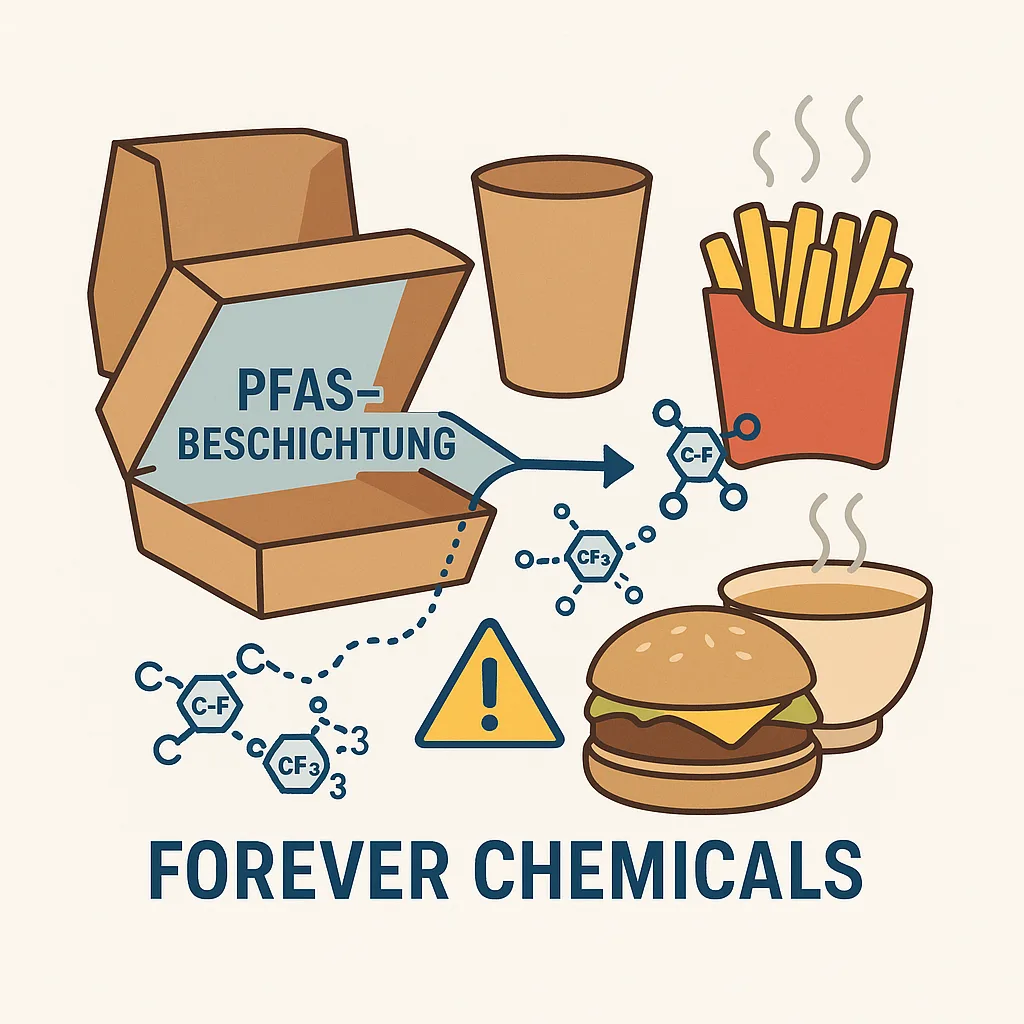
    The abbreviation “PFAS” stands for per- and polyfluoroalkyl substances. This is a large group of several thousand chemicals (approximately 5,000 – 15,000 depending on the source of information) that have been used for decades in numerous industrial and consumer applications due to their water-, fat- and dirt-repellent properties. They are particularly common in paper-based food packaging – such as fast food packaging, pizza boxes or microwave popcorn bags. For food contact materials, the most well-known representative of this group is polytetrafluoroethylene, which is used under the trade name “Teflon®” for non-stick coatings on cookware (pots, pans), for example.
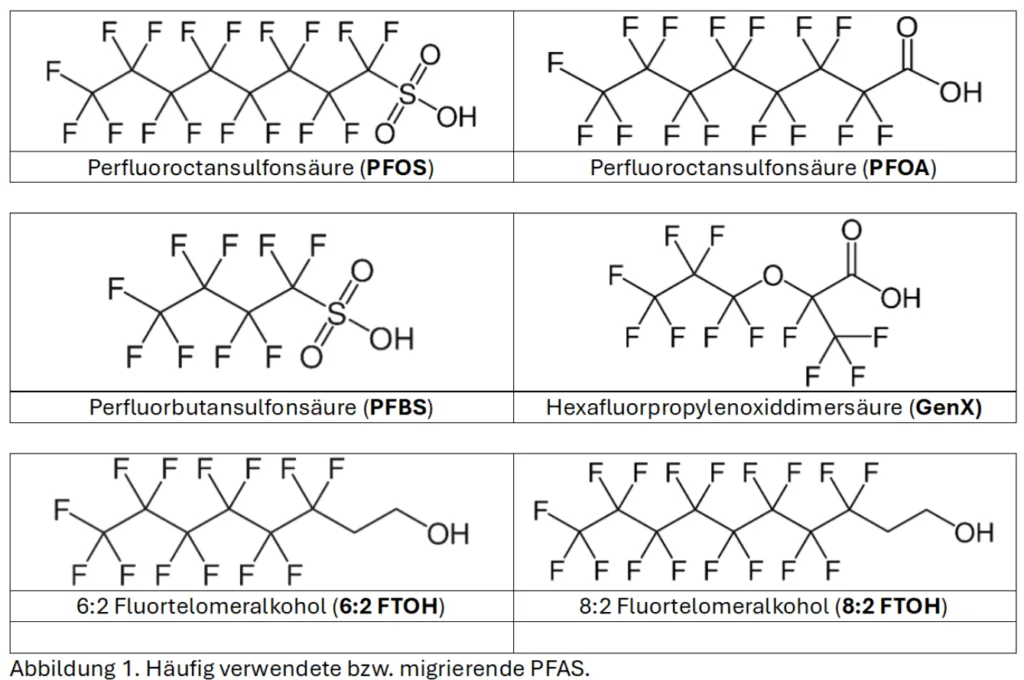
    PFAS

    At the latest since the entry into force of the “PPWR” (Packaging and Packaging Waste Regulation – Regulation (EU) 2025/40), the topic of PFAS is on everyone’s lips and leads to uncertainty for many about how to deal with these substances.

    This article gives you a brief overview of the most important information on the topic of PFAS and answers the question of whether and how you should act as a manufacturer/user of food packaging.

    Migration from Packaging into Food

    PFAS are particularly problematic because they are chemically extremely stable, i.e. they resist biological degradation, heat, light and chemicals. They are frequently used in paper-based food packaging to ensure moisture and fat resistance, but they are also used in flexible film packaging as extrusion aids or process additives. These “forever chemicals” can then migrate from (coated) packaging into food, especially upon contact with hot, greasy or liquid foods. Studies show that foods from PFAS-coated packaging can absorb significant amounts of these substances or their reaction products.

    An important aspect: Even packaging declared as “compostable” or “sustainable”, for example made from molded pulp, often contains PFAS to achieve the necessary barrier properties against fat and moisture. Such materials can release PFAS during composting, which then re-enter the environment and thus potentially back into the food chain via soils, plants or animal feed.

    Health Risks and Alternatives

    PFAS are extremely persistent and bioaccumulative, accumulating primarily in blood, liver and lungs. The majority of human exposure occurs through diet, according to estimates around two thirds, as well as through drinking water and house dust. The chronic intake of PFAS through contaminated food poses an ever-growing risk. The health risks are now well documented, especially long-chain PFAS (e.g. PFOA, PFOS) are associated with health problems such as reproductive disorders, immunosuppression and tumor formation. But even newer, short-chain alternatives such as GenX (named after the manufacturing process) or PFBS show toxicological effects and are critically evaluated due to their high mobility and environmental persistence. (G. Glenn et al. Per‑ and polyfluoroalkyl substances and their alternatives in paper food packaging. Comprehensive Reviews in Food Science and Food Safety, 2021)

    Given the known risks, there is a growing need for PFAS-free, functionally equivalent but also biodegradable packaging solutions. Alternatives currently being tested, for example based on polysaccharides (e.g. starch, chitosan), proteins or polylactic acid (PLA), have so far achieved only limited success in achieving the desired fat and moisture barrier properties.

    Analytical Challenges

    The challenge in PFAS analysis lies in their structural diversity and the low concentration in which they occur. Modern analytical methods such as liquid chromatography coupled with high-resolution mass spectrometry (LC-QTOF, LC-MS/MS) enable the detection of even the smallest amounts in various matrices, including food and environmental samples. These systems also allow the identification of previously unknown PFAS or degradation products – an important prerequisite for regulations and risk assessments. However, these methods cannot ensure that all PFAS are detected and quantified, so the total fluorine content is often determined by combustion in an oxygen bomb and ion chromatography. However, this does not separate inorganic and organic fluorides, so misinterpretations are possible.

    PPWR: A Regulatory Turning Point

    Regulation (EU) 2025/40, a central EU initiative on the circular economy, provides comprehensive regulations for packaging with the aim of significantly reducing packaging waste by 2040 and making materials safe and recyclable. Particularly relevant: the PPWR contains clear requirements for the safety of food contact materials.

    The current regulation text explicitly targets the reduction of “substances of concern” in packaging – PFAS are in focus. Manufacturers must in future demonstrate that their packaging is free from persistent, bioaccumulative and toxic substances such as PFAS. Thus, after the expiry of the transition period on 12.08.2026, food packaging may no longer be placed on the market if it contains PFAS in the following concentrations:

    • 25 ppb for each individually analyzed PFAS (excluding polymeric PFAS)
    • 250 ppb for the sum of PFAS, measured as the sum of targeted analysis and, where applicable, degradation of precursor compounds (excluding polymeric PFAS)
    • 50 ppm for PFAS (including polymeric PFAS); if the total fluorine content exceeds 50 mg/kg, the producer or importer must provide evidence of the amount of measured fluorine upon request.

    These regulations are particularly relevant for manufacturers of food packaging, who can already check whether action is needed by measuring the total fluorine content.

    If you have any questions, please contact fcm@innoform.de. We will be happy to provide you with a quote for the determination of total fluorine content.

    You can find tests for PFAS here.

    An article by Dr. Tim Schlüter

    Tim Schlüter
  • Regulation (EU) 2024/3190 (BPA)

    Regulation (EU) 2024/3190 (BPA)

    Overview of the regulation

    The EU BPA Food-Contact Ban results in a ban on the use of bisphenol A and bisphenol derivatives

    On 19 December 2024, the European Commission issued a ban on the use of Bisphenol A (BPA) and its salts in materials that come into contact with food. Regulation (EU) 2024/3190 extends the existing restrictions on BPA, which is already banned in the European Union for use in baby bottles. The regulation also contains restrictions for other bisphenols and bisphenol derivatives.

    Repeal of Previous SML & Transitional Periods

    The Specific Migration Limit (SML) for Bisphenol A of 0.05 mg/kg that has applied to date was repealed when the regulation came into force on 20 January 2025. However, a transitional period until 20 July 2026 or 20 January 2028, as the case may be, applies to certain uses.

    Affected Food Contact Materials

    The regulation (EU BPA Food-Contact Ban) applies to food contact materials made of plastics, rubbers and silicones, but also to varnishes and coatings, adhesives, printing inks and ion-exchange resins. The requirements do not currently apply to paper, as BPA is not generally used intentionally in this area.

    Other Regulated Bisphenols & Derivatives

    In addition to bisphenol A, other bisphenols and bisphenol derivatives, are also regulated:

    GENERAL STRUCTURE:

    Bisphenol:

     Ein Bild, das Diagramm, Reihe, Origami, Design enthält.

KI-generierte Inhalte können fehlerhaft sein. 
     
    including the salt form 
    Bisphenolderivate: 


    Ein Bild, das Diagramm, Reihe, weiß, Design enthält.

KI-generierte Inhalte können fehlerhaft sein. 
      
     with the exception of the salt form 
     X: bridge group, for the separation of both phenyl rings by a single atom, which can have any substituent(s). 
    R1 to R10: substituents, of which at least one is not hydrogen 

    Bisphenols and bisphenol derivatives are considered hazardous under the terms of the regulation if they are classified as carcinogenic, mutagenic (cat. 1A and 1B), toxic for reproduction or as an endocrine disrupting for human health (cat. 1) in accordance with the CLP Regulation (EC) 1272/2008.

    The regulation prohibits the use of BPA and its salts, as well as other hazardous bisphenols or hazardous bisphenol derivatives, in the manufacture of food contact materials and the placing on the market of products made with these materials. If other bisphenols or bisphenol derivatives are used, they must not contain BPA residues above a detection limit of 1 µg/kg.

    The following measures are recommended:

    Food contact materials made of: plastic, rubber, silicone, varnishes and coatings, adhesives, printing inks, ion-exchange resins Manufactured with 
    bisphenol A 
    Manufactured with other hazardous bisphenols/ bisphenol derivatives Manufactured with other bisphenols/ bisphenol derivatives Manufactured without 
    bisphenols/ bisphenol derivatives 
    (or currently unknown) 
    Search for alternatives (until 20 July 2026) (if no exception applies) x x     
    Request Declarations of Compliance  
    (= supporting documentation)  
    from suppliers 
        x x 
    Test residual content of BPA     x   
    Test migration of BPA x 
    (with exception) 
    x 
    (with exception) 
        
    Create Declaration of Compliance /  
    add to Declaration of Compliance for plastics 
    x x x x  
    (if supporting documents are available) 

    Compliance Declaration: Requirements

    For plastics, a separate Declaration of Compliance in accordance with Regulation (EU) 2024/3190 is not required if the following additions are included in the declaration in according to Regulation (EU) No. 10/2011:

    • Current telephone number or email address
    • Confirmation that the food contact material complies with Regulation (EU) 2024/3190 : EU BPA Food-Contact Ban
    • Confirmation that no bisphenols or bisphenol derivatives as defined in Regulation (EU) 2024/3190 were used in the manufacture of the products or a list of all bisphenols or bisphenol derivatives used in the manufacture of the food contact material or article

    If necessary, it can be added that the confirmation is based on information from the raw material suppliers.

    For more information, please refer to our flyer, which you can request here: https://innoformtestservicede.sharepoint.com/:b:/s/InnoformGmbH/EdTh6prd_s5MhH-PJSk4lFgB03bCMjPYZ8K2zDJKDzIKQA?e=efl7Gf

    If you have any questions, please contact fcm@innoform.de. We will be happy to provide you with a quote for the inspection of your documents, the measurement of the BPA content or the BPA migration.

  • 19th Amendment of the Plastics Regulation (EU) No. 10/2011

    19th Amendment of the Plastics Regulation (EU) No. 10/2011

    New regulations for plastics in food contact by Regulation (EU) 2025/351 have been published.

    Important amendments to the EU regulations on plastic food contact materials are presented here. These include amendments to Regulation (EU) No. 10/2011, amendments to Regulation (EU) 2022/1616 on recycled plastics and amendments to Regulation (EC) No. 2023/2006 on good manufacturing practice.

    Important clarifications concern the definitions and requirements for plastics, the introduction of “UVCB substances”, purity requirements, regulations on reprocessing and recycling, new labelling regulations and extended declarations of conformity. In addition, rules on conformity testing and transition periods are specified.

    1. Amendments to existing regulations:
      • Amendments to Regulation (EU) No. 10/2011 on plastic materials and articles that come into contact with food.
      • Amendments to Regulation (EU) 2022/1616 on recycled plastics and repeal of Regulation (EC) No 282/2008.
      • Amendments to Regulation (EC) No 2023/2006 on good manufacturing practice.
    1. Clarifications and precisions:
      • Definitions and requirements for the composition of plastics have been specified.
      • Introduction of the term “UVCB substances” (substances with unknown or variable composition).
      • Extent and nature of evidence to demonstrate compliance and composition of starting materials at each stage of the manufacturing process
    1. Purity requirements:
      • Specification of high purity levels for substances used in the manufacture of food contact materials.
      • Specific regulations for the purity of substances of natural origin.
    2. Reprocessing and recycling:
      • Regulations for the reprocessing of plastic by-products.
      • Requirements for quality assurance systems in recycling plants.
    3. Labelling and declaration of conformity:
      • New labelling regulations for reusable food contact materials.
      • Extended requirements for the declaration of compliance, including information on not intentionally added substances (NIAS)
    4. Examinations
      • Rules on conformity testing and assessment of compliance with limit values clarified
      • Criteria for assessing the stability of reusable materials and objects
    5. Transition periods:
      • 18 months first placing on the market
      • 9 months before the end of the transition period, information of the customer if the requirements have not yet been met.

    You can find the regulation here: Regulation – EU – 2025/351 – EN – EUR-Lex

    Contact: Heike Schwertke

  • White Paper: Compliance Testing of Food Contact Materials

    White Paper: Compliance Testing of Food Contact Materials

    Why they are indispensable

    Safety and Compliance of Food Packaging 

    Food contact materials – primarily packaging in this context – are subject to special regulations. They not only serve to protect food, but also influence its safety and quality. But how can it be ensured that these materials comply with strict legal requirements? Our new white paper “Compliance Testing of Food Contact Materials” provides a comprehensive overview of current regulatory requirements, relevant testing procedures and practical solutions for users of food contact materials as well as manufacturers and processors in the packaging industry. 

    Which tests are required? 

    The type of tests required depends on the materials used, the manufacturing process and the intended use. Our white paper explains in detail: 

    • Overall migration testing: Ensuring that no impermissible amounts of substances transfer to the food. 
    • Specific migration tests: Proof that individual, potentially concerning substances remain below legal limits. 
    • Sensory tests: Testing for changes in odor, taste and appearance. 
    • Risk assessments: Identification of potential hazards from contaminants or degradation products. 

    Regulatory Requirements and Challenges 

    In addition to EU Regulation (EC) No. 1935/2004, numerous other legal requirements apply, such as the Plastics Regulation (EU) No. 10/2011 or the GMP Regulation (EC) No. 2023/2006. National regulations and individual measures for specific materials, such as metals, printing inks or recycled plastics, must also be observed. 

    Particularly challenging is the proof of compliance in complex supply chains, which is typically based on declarations of compliance from suppliers. However, these documents alone are not sufficient – careful plausibility checks and, if necessary, own tests are required to minimize regulatory risks. 

    Benefits of our White Paper for Your Company 

    Our white paper provides valuable information for all companies working with food contact materials, especially in the packaging industry: 

    • Legal certainty: Avoid liability risks and ensure compliance with all relevant regulations. 
    • Quality management: Optimize your internal processes for compliance assessment. 
    • Market advantages: Documented compliance strengthens the trust of customers and business partners. 
    • Practical solutions: Concrete recommendations for action and checklists for implementation in your company. 

    Request now for free! 

    Don’t miss the opportunity to expand your knowledge about compliance testing and make your company more legally secure. Request our free white paper “Compliance Testing of Food Contact Materials” now and benefit from well-founded expertise and practical tips directly from our laboratory in Oldenburg. 

    Request your personal copy directly from our test service

    Or also feel free to request the guide directly from Heike Schwertke by phone at 0441 94986 14 

  • 11th amendment of Regulation (EU) no. 10/2011 has been published

    11th amendment of Regulation (EU) no. 10/2011 has been published

    With the 11th amendment of Regulation (EU) no. 10/2011 two new substances have been added to the list of substances in annex I, and the specific migration limit for two listed substances (perchloric acid, salts (perchlorate) (FCM No 822) and phosphorous acid, mixed 2,4-bis(1,1-dimethylpropyl)phenyl and 4-(1,1-dimethylpropyl)phenyl triesters (FCM substance No 974 and CAS No 939402-02-5) have been amended. Plastic materials and articles complying with Regulation (EU) No 10/2011 as applicable before the entry into force of this Regulation, may be placed on the market until 26 June 2019 and may remain on the market until exhaustion of stocks. Please find here the regulation in different European languages: https://eur-lex.europa.eu/legal-content/DE/TXT/?uri=CELEX:32018R0831