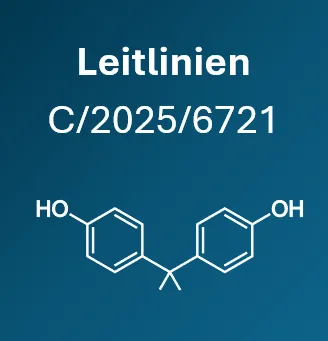
Regulation (EU) 2024/3190, which was adopted in December 2024, banned the use of bisphenol A (BPA) and its salts in food contact materials. But what exactly does that mean?
On 17 December 2025, the EU published Guideline C/2025/6721. This guideline answers practical questions on five main areas.
1. Scope of application of the Regulation
- Which materials are affected?
- What exceptions apply (e.g. paper/cardboard, enamel, materials intended to come into contact with pet food)?
- Handling of recycled materials.
- Definitions: semi-finished vs. finished food contact materials.
2. Other bisphenols and bisphenol derivatives
- Which additional bisphenols are also prohibited?
- Procedure for the approval of hazardous bisphenols (e.g. BPS).
- Requirements for risk assessments in accordance with EFSA guidelines.
- Substances currently classified as hazardous: BPS, BPAF, TBBPA, 4,4′-isobutylethylidene diphenol, phenolphthalein.
3. Compliance and auditing
- Proof of compliance: documentation, migration tests, modelling.
- Implementation of the detection limit for BPA: 1 µg/kg.
- Obligation to declare compliance – even without the use of BPA.
- Responsibilities within the supply chain.
4. Placing on the market
- Regeln für Export in Drittländer und Import aus Drittländern.
- Umgang mit BPA in Lebensmitteln aus externen Quellen.
5. Transitional provisions
Deadlines for placing on the market:
- 18 months (until July 2026) for most materials.
- 36 months (until January 2028) for certain packaging and equipment.
- Additional 12 months for filling.
- Sale of filled single-use materials until stocks are exhausted.
- Differences between single-use and reusable materials.
- Special rules for commercial equipment.
If you have any questions, please contact fcm@innoform.de. We will be happy to help you review your documents, measure BPA content or BPA migration.