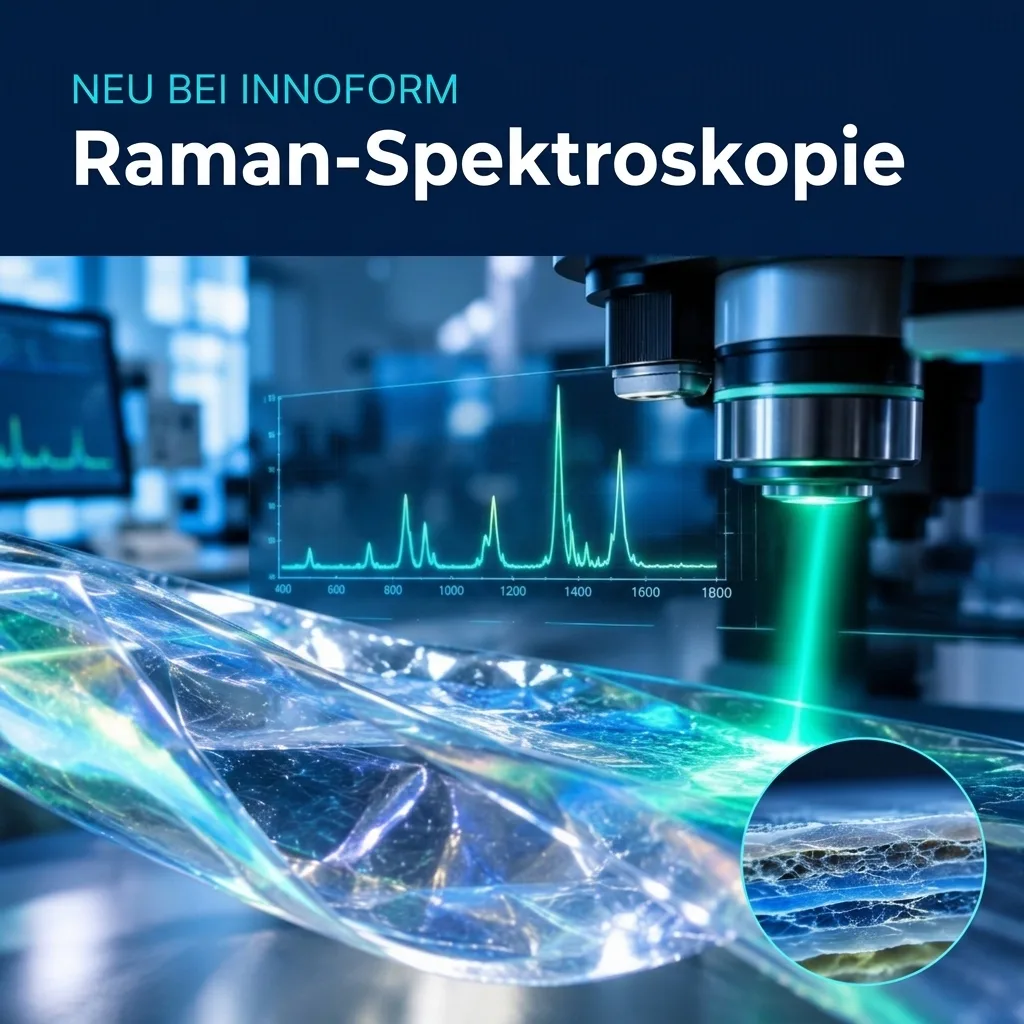
A small foreign particle. An unexpected discoloration. A layer in a film laminate that cannot be clearly identified.
Such questions are part of everyday life in the packaging and plastics industry. The critical question then often is: What exactly is the material made of?
To answer this question even more precisely in the future, Innoform is expanding its analytical portfolio to include Raman spectroscopy. The method is among the most powerful tools in modern material analysis and provides insights down to the molecular level.
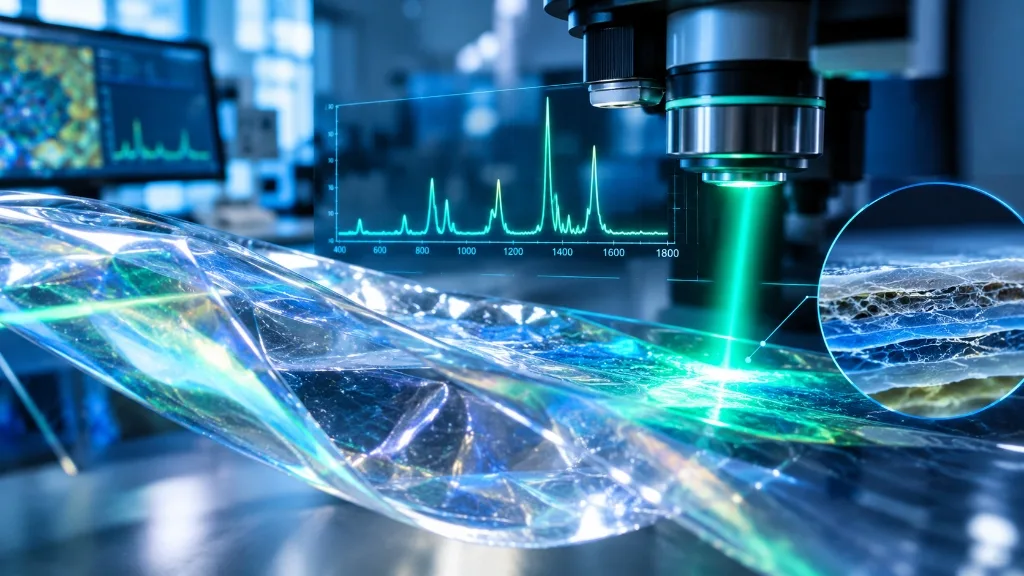
Making chemical fingerprints visible
Raman spectroscopy uses laser light to obtain information about the molecular structure of a material. This creates a characteristic spectrum for each substance – virtually its chemical fingerprint.
These spectra can be compared with reference databases. This allows many materials to be identified and distinguished from one another, such as plastics, pigments, coatings, adhesives, or unknown particles. The method thus ideally complements existing spectroscopic techniques.
Why we are expanding our analytical portfolio
In recent years, packaging and technical films have evolved continuously. Mono-material solutions, functional coatings, complex laminate structures, and increasing requirements for quality and sustainability present new challenges for analytical testing as well.
At the same time, customers expect fast and reliable answers when dealing with complaints, material comparisons, or development projects.
With Raman spectroscopy, we now have an additional method to address precisely these types of questions in an even more targeted manner.
When micrometers matter
A key strength of Raman spectroscopy lies in its high spatial resolution. This allows even the smallest structures or particles to be examined that are barely visible to the naked eye. Frequently, only minimal or even no sample preparation is required.
For our customers, this means:
- More information from minimal sample quantities
- Additional certainty in material identification
- Faster root cause analyses for anomalies
- Supplementary insights for development projects
Raman and FTIR: Stronger together
Infrared spectroscopy (FTIR) has been an established tool for material characterization at Innoform for many years. Raman spectroscopy does not replace this method; rather, it complements it.
Both procedures view materials from different analytical perspectives. What one method detects particularly well can often be confirmed or supplemented by the other. The combination of both methods therefore frequently leads to significantly higher identification reliability.
Where the new method is used
The applications are versatile. These include, among others:
- Material identification of plastics and films
- Examination of multilayer packaging structures
- Analysis of coatings and printing inks
- Particle and foreign body analysis
- Failure analysis and complaint management
- Support for research and development projects
Particularly in complex cases where multiple analytical methods must be combined, Raman spectroscopy often delivers decisive additional information.
Another building block for well-founded answers
Materials are becoming increasingly complex. Consequently, the demands placed on their testing are also rising. With the introduction of Raman spectroscopy, Innoform expands its analytical capabilities with a powerful method that meaningfully complements the existing range of methods.
Or put another way: When a sample raises questions, we now have another way to find answers.
Are you facing a material analysis challenge? Contact us. Together, we will find the right analytical approach for your inquiry.