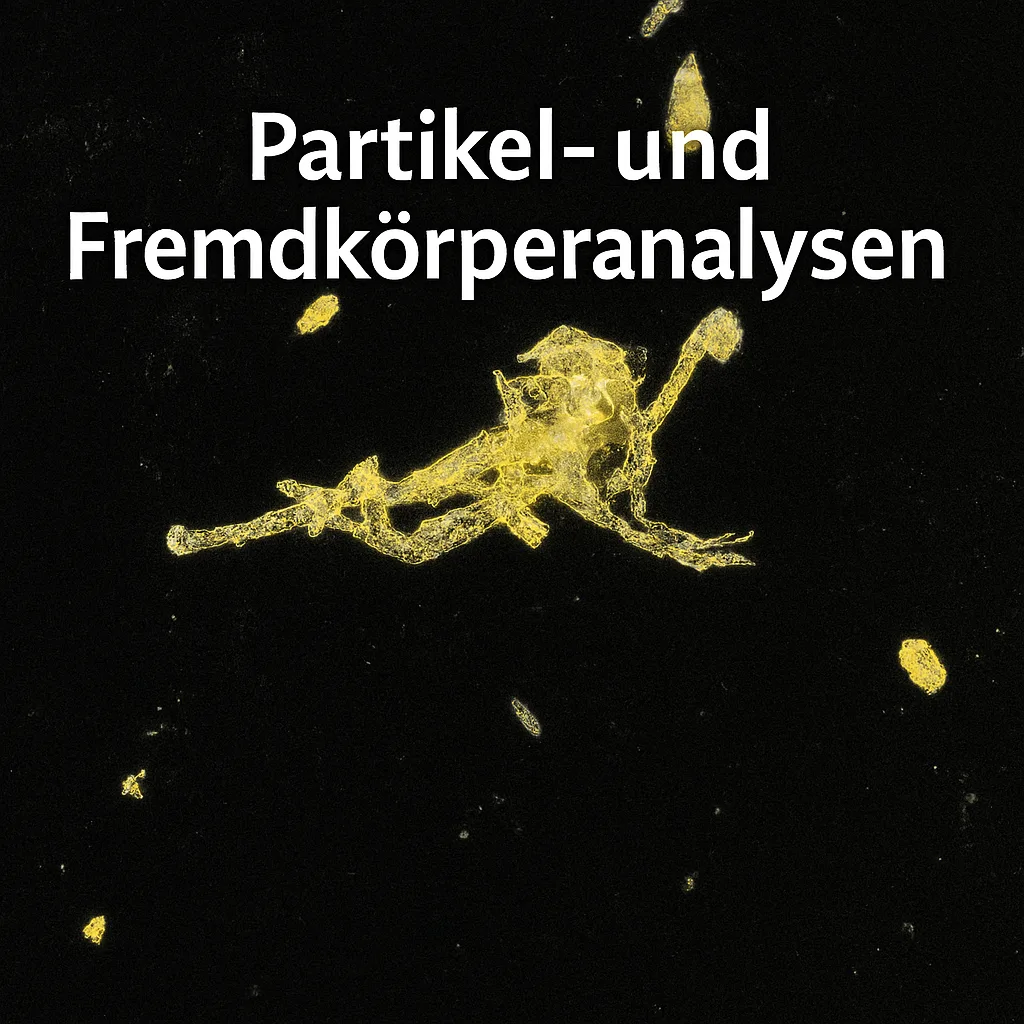
Precise Characterization for Quality, Safety and Root Cause Clarification
Particles and unwanted foreign bodies represent a significant quality and risk potential in the manufacture and processing of flexible packaging. Especially with polymer-based materials, multi-layer systems or functional coatings, even the smallest contaminations lead to functional failures, optical impairments or regulatory complaints. The systematic analysis of such anomalies is therefore a central component of modern quality assurance and damage investigation along the entire value chain.
Definition: Particle vs. Foreign Body Analysis
Particle analysis examines the size, shape, number and material properties of the smallest particles on or within a product. Foreign body analysis goes beyond this: it identifies substances that do not belong to the intended material composition. The goal is to clearly characterize the nature of the particles and precisely determine their origin. On this basis, causes can be narrowed down, process steps optimized and future deviations avoided.
Systematic Microscopy at Innoform
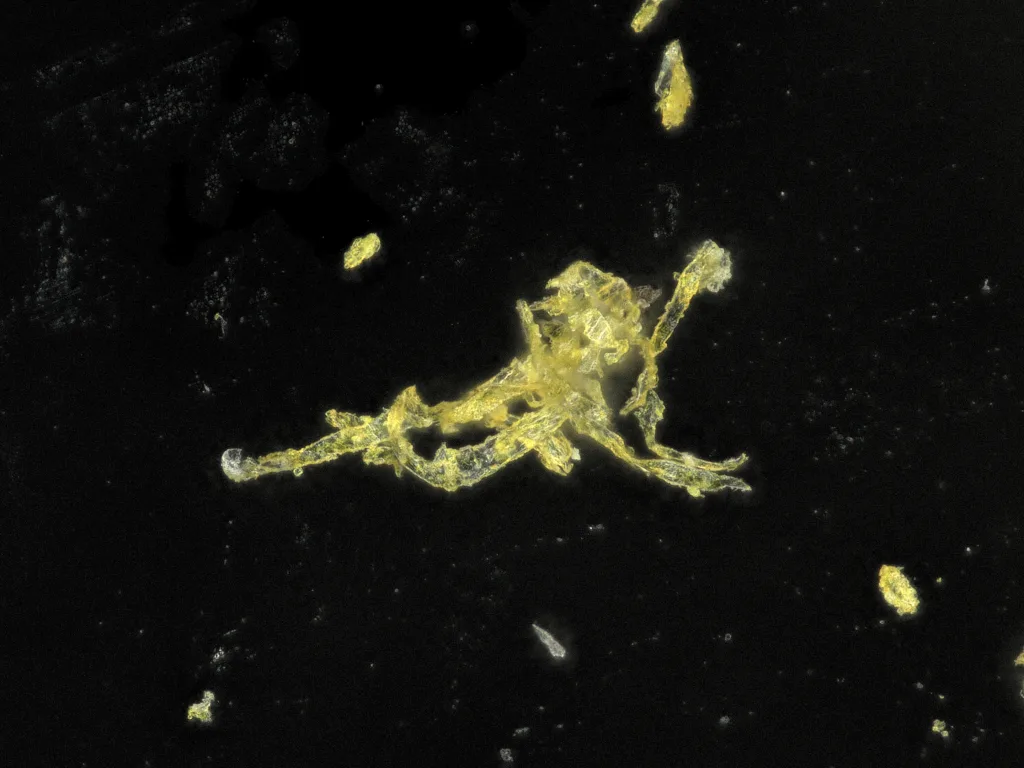
At Innoform, particle and foreign body analyses are performed using high-quality light microscopy systems that enable differentiated assessment. Each examination begins with systematic image documentation. First, overview images are created to capture the position, distribution and embedding situation of the anomaly in the overall context. This is followed by detailed microscopic examination at higher magnification. This two-stage approach ensures both classification within the sample matrix and precise analysis of morphological details.
Preparation of Composite Materials and Cross-Sections
Special importance is attached to sample preparation. If particles are enclosed in the matrix – for example in a plastic film, a coating or a complex composite material – the production of a cross-section is often required. Through targeted cutting technique or micromechanical preparation, the embedding situation is exposed. Interfaces, adhesion states and possible interactions between matrix and foreign body become assessable. Especially with multi-layer systems, the cross-section provides valuable indications of which process stage (e.g. extrusion or lamination) a contamination was introduced.
Material Identification by Means of IR Spectroscopy
Morphological examination is often only the first step. For identification of material composition, we use among other methods infrared spectroscopy (IR). It allows the determination of molecular structures based on characteristic vibrational bands. Innoform uses IR analytics in both reflectance and transmission mode. The choice of technique depends on the nature and transparency of the particle. By comparison with reference databases, organic materials – such as polymers, adhesives, coating components or external contaminations – can be clearly identified.
Complementary Methods: Raman and Thermal Analysis
In addition, Raman spectroscopy can be used. It offers high lateral resolution for the smallest particles and often allows analysis directly in the embedded state. The combination of IR and Raman spectroscopy significantly increases identification reliability. In special cases, thermal methods such as differential scanning calorimetry (DSC) provide additional insights into melting behavior or thermal stability. This is particularly helpful with polymeric foreign bodies to distinguish materials from one another or to obtain indications of additives.
Conclusion: Process Safety for Converters and Fillers
The strength of a well-founded analysis lies in the systematic combination of all information. Morphology, chemistry and thermal behavior yield a coherent overall picture. This enables conclusions about potential sources of entry – such as abrasion from machine components, contaminations from raw materials or residues from cleaning processes. This offers companies decisive advantages: complaints can be objectively evaluated and regulatory requirements, for example for food contact materials, can be reliably documented. Professional analytics is thus an indispensable instrument for securing product integrity.