
How do paper laminates change over time? Accelerated shelf-life testing and subsequent material testing help identify aging effects at an early stage and soundly evaluate packaging concepts.
Sustainable packaging needs more than good initial values
The shift toward paper-based packaging solutions continues to grow. Driven by sustainability goals, regulatory requirements, and the desire for higher recyclability, new paper laminates are constantly being developed for food, consumer goods, and technical applications.
How does the packaging behave after months or years of storage?
Packaging must maintain the product properties relevant to the specific application throughout its entire intended service life. Depending on the contents, this may include protection against moisture uptake, oxygen ingress, loss of aroma, or oil penetration. This is where accelerated shelf-life testing and subsequent material testing come into play.
The challenge with paper laminates
Paper offers several ecological advantages. At the same time, it differs fundamentally from conventional plastic laminates.
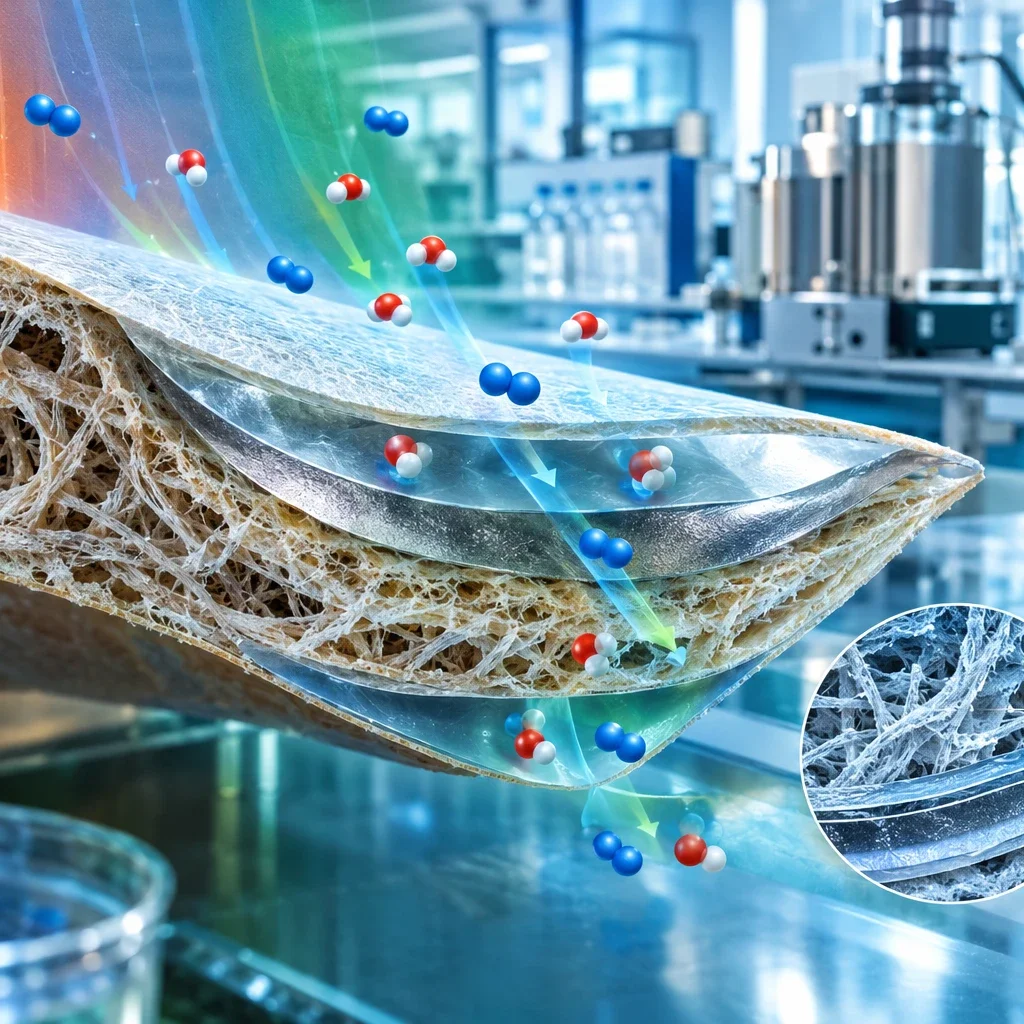
While many plastic films derive their functional properties primarily from their polymer structure, paper laminates consist of multiple layers of different materials. Paper layers, coatings, functional barrier layers, or sealing layers must interact permanently.
- Effects of moisture
- Temperature fluctuations
- Aging of coatings
- Changes in adhesive systems
- Mechanical stresses during transport and storage
These factors can cause functional properties to change over time, even if the material still meets all requirements immediately after production.
Why real-time storage is often not an option
Anyone wanting to know how a packaging material behaves after two, three, or even five years could theoretically just wait. In product development, however, this is rarely practical. New packaging concepts must be evaluated within significantly shorter development cycles. Manufacturers need early data for development decisions, approvals, or risk assessments.
This is where accelerated shelf-life testing provides a practical decision-making tool. Under elevated temperatures, aging processes can be targetedly accelerated. Based on a defined model, for example using the Arrhenius equation, a longer real-time storage period is mathematically mapped against a shorter test duration at an elevated temperature.
Importantly, accelerated aging tests do not deliver an exact prediction of actual shelf life. Elevated temperatures may exaggerate individual aging effects, while other effects may be underestimated due to the shortened timeframe. The results should therefore be understood as indicative values and as a component of risk management.
Do not underestimate climatic boundary conditions
Especially with paper laminates, the test result strongly depends on environmental conditions. Paper is hygroscopic and reacts to changes in humidity. As a result, properties such as stiffness, strength, dimensional stability, and barrier properties can change.
The conditions during storage, conditioning, and testing should therefore be tailored to the intended application, carefully defined, and fully documented. Changes can only be reliably evaluated under comparable conditions.
Verification is provided through subsequent functional testing
Accelerated storage alone does not answer the crucial question: Has the protection or utility function of the material changed? Therefore, the aged samples are compared with a suitable unaged control sample or initial values.
Depending on the application, permeation testing or seal integrity testing is the main focus:
- Oxygen transmission rate (OTR)
- Water vapor transmission rate (WVTR)
- Integrity and leak tightness of packaging and packaging components
Temperature and relative humidity influence permeation rates. The test conditions must therefore align with the real-world application and be taken into account when interpreting the results. The measurement reveals whether the permeability of the material or packaging has changed as a result of storage.
Aging affects more than just the barrier
A single test is often insufficient for a sound evaluation of long-term stability. Paper laminates are complex material systems. Changes can occur in different areas and manifest not only in altered permeation values. Frequently, an application-specific combination of several test methods is therefore recommended.
Bond strength and layer lamination
Many modern paper packaging concepts consist of multiple functional layers. Paper layers are combined with barrier coatings, sealing layers, or thin polymer layers. Temperature and aging effects can alter the adhesion between these layers. Reduced bond strength can lead to delamination. Depending on the structure, this can cause functional impairments, for example in mechanical stability or individual barrier properties. Peel tests and bond strength analyses provide information on the durability of the material structure.
Grease resistance and oil resistance
For packaging used for baked goods, confectionery, snacks, or other fatty foods, grease resistance can play a key role. Temperature and moisture influences can alter the structure or surface characteristics of functional barrier coatings. Whether this affects grease resistance must be investigated through suitable, application-specific testing. The test should match the intended product, contact time, and subsequent exposure.
Mechanical properties
Paper is sensitive to climatic factors. Depending on the construction and application, the following properties may also be evaluated:
- Tensile strength
- Tear strength and tear propagation resistance
- Stiffness
- Folding and flex resistance
- Puncture or burst strength
Even with stable barrier values, packaging can become unsuitable in practice if its mechanical stability decreases significantly during storage.
Sealing properties and leak tightness
In flexible packaging, overall performance is significantly influenced by heat seals, adhesive bonds, and closure areas. Therefore, tests for heat seal strength, sealing behavior, or seal integrity can be essential components of an aging program. For paper laminates with heat-sealable functional layers, it must be verified whether the intended processing characteristics and seal strength are maintained after storage.
Optical and sensory properties
Optical and sensory changes can also be relevant for product protection and market acceptance. Typical testing aspects include:
- Discoloration or yellowing
- Changes in surface appearance
- Odor development or sensory perceptible substance transfer
- Changes in printability and haptics
Practical example: Paper laminate for dry food
A common practical example is the development of a paper laminate for cereals, milk powder, instant products, or dry mixes. In such applications, protection against moisture absorption is often the primary focus. For oxidation-sensitive products, an oxygen barrier may additionally be required.
First, the relevant properties are determined on an unaged control sample. Subsequently, accelerated storage is carried out under defined conditions. At specified sampling intervals, the selected tests are repeated—for instance WVTR, OTR, bond strength, grease resistance, mechanical characteristics, sealing properties, or seal integrity.
The comparison shows whether the properties relevant to the application remain stable or whether changes are becoming apparent. On this basis, material structure, coating, processing, or test programs can be specifically further developed.
Limits of accelerated aging
Accelerated storage is not a complete substitute for storage under real conditions. Not every aging mechanism follows the same temperature model. Relative humidity, mechanical stress, light, oxygen availability, contact with the contents, and cyclic climates can also influence aging.
For critical applications, it is therefore sensible to combine accelerated tests with parallel real-time storage. Accelerated aging provides early indications, while real-time storage serves to validate the chosen approach at a later stage.
Sustainability needs long-term stability
Paper laminates are considered an important building block for future packaging concepts. For sustainable solutions to be functionally convincing as well, they must demonstrate their performance over the intended service life.
The combination of accelerated storage and subsequent application-specific testing provides a valuable data foundation for this purpose. Permeation measurements can be supplemented by investigations into bond strength, grease resistance, tightness, seal quality, as well as mechanical and sensory properties.
In this way, risks can be identified at an early stage, materials optimized in a targeted manner, and development decisions made on a sounder basis. After all, it is not just the choice of material that determines the success of packaging, but its ability to reliably fulfill the required function under the intended conditions.
Please send questions and suggestions regarding test programs for paper laminates to daniel.wachtendorf daniel.wachtendorf@innoform.de
