Many companies are currently facing the challenge of understanding and implementing the specific requirements of the new EU Regulation 2025/40 on packaging and packaging waste. The following article is based on a web seminar* by Innoform Coaching and provides a practice-oriented overview of the central content of the regulation – from stricter recycling quotas to extended producer responsibility. A compact overview of obligations, deadlines and areas of action is included for implementation.
Dieter Finna
The European Packaging Regulation EU 2025/40, known as the Packaging and Packaging Waste Regulation (PPWR), forms the updated legal framework for packaging and packaging waste in the European Union.
It replaces the previous Packaging Directive 94/62 EC and amends, among others, Regulation (EU) 2019/1020 (Compliance Regulation) and Directive 2019/904 (Single Use Plastic). The aim of the regulation is to significantly reduce packaging waste, promote recycling and circular economy, and harmonize requirements within the European Union. It entered into force on February 11, 2025 and applies directly in all EU Member States, meaning that implementation into national laws is not required. With entry into force, a transitional period of 18 months began, after which the provisions of the regulation are to be applied bindingly from August 2026.
The PPWR comprises 71 articles and 12 annexes and forms a comprehensive legal framework that is not fully formulated in many parts. Numerous specific requirements will be supplemented by delegated acts and implementing acts, which will be determined step by step by the EU Commission and published in good time before the respective obligations enter into force.
Definition of Roles
The PPWR explicitly describes the various roles from which the specific obligations of the actors are derived. A novelty is the distinction between producers and manufacturers. A producer is defined as the one who manufactures packaging or a packaged product. A manufacturer is the one who places the packaging (as a producer, importer or distributor) on the market. An importer is the one who places packaging or packaged products from a third country on the Union market. They have particular due diligence obligations regarding compliance.
Responsibility as Producer and Manufacturer
Manufacturers are subject to extended producer responsibility (EPR), which is described in detail in the PPWR. Manufacturers are obliged to ensure recyclable packaging design (Design for Recycling, DfR) and they bear responsibility for the design, material selection and labeling of packaging. Even if packaging is manufactured by a producer, responsibility for its compliance and recyclability remains with the manufacturer.
The producer, in turn, is obliged to develop and provide suitable materials that meet the requirements for recyclability and sustainability. In addition, they must provide technical evidence and a declaration of compliance for the packaging product. As the producer, they have detailed knowledge of the material composition and are therefore obliged to provide the technical evidence.
Restriction of Hazardous Substances
Packaging placed on the market must be manufactured in such a way that the concentration of substances of concern in packaging material or packaging components is kept to a minimum. The regulation refers in Article 5(4) to Regulation (EC) No 1935/2004, according to which the sum of the concentrations of lead, cadmium, mercury and hexavalent chromium from substances in packaging or packaging components must not exceed 100 mg/kg.
For packaging that comes into contact with food, limit values for PFAS (per- and polyfluorinated alkyl substances) are also set, which will apply from 2026. They are detailed in Article 5(5). This affects, for example, PFAS-containing processing aids that are added during the extrusion of films to reduce friction. Clear limits are set here.
Reduction of Packaging Volume
Currently, packaging accounts for 40% of plastic consumption in the European Union. By 2030, the packaging volume is to be reduced by 5%, by 2035 by 10% and by 2040 by 15%, based on the reference year 2018. This is to be implemented through avoidance of unnecessary packaging, reduction of packaging material, promotion of reusable systems and reduction of single-use packaging.
Recyclability of Packaging
Packaging materials should be reused as secondary raw materials as often as possible. This presupposes their recyclability, particularly for polymers, which Article 6 specifies at the Design for Recycling (DfR) level by 01.01.2030. From 01.01.2035, recyclability also applies “at scale”, i.e. on an industrial scale in a corresponding material stream. What exactly recycling at scale means will be issued by the Commission in an implementing act by 01.01.2030.
In the future, there will be three performance levels for packaging material, which indicate the percentage of its recyclability. The exact criteria for determining the performance levels will be issued by the Commission by 01.01.2028. Level A will include materials that are ≥ 95% recyclable, B materials that are ≥ 80% and C those that are ≥ 70% recyclable. Materials with a recyclability < 70% count as technically non-recyclable materials. From 2030, there will be a ban on placing them on the market, which will also extend to performance level C materials from 01.01.2038.
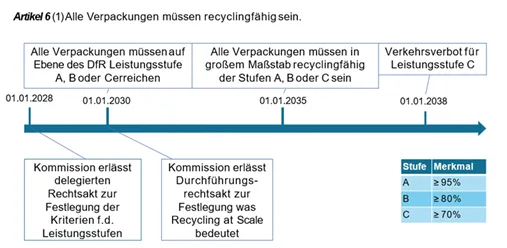
Article 6(1) of the PPWR, Recyclability (Source: Dr. Andreas Grabitz, presentation “Regulatory Challenges” Inno-Meeting, Osnabrück, Feb. 2025)
Minimum Recycled Content in Plastic Packaging
By 2030, PET packaging must contain 30% recycled content, other contact-sensitive packaging 10%, and non-contact-sensitive packaging 35%. When selecting materials, mono-materials and non-colored materials are preferred to increase recyclability.
For pharmaceutical packaging, the requirements of the PPWR regarding minimum recycled content do not apply until 2038. The reason for this is the particular sensitivity in this sector – there must be no transfer of packaging materials to the medicine. In 2038, it will be reassessed at the European level whether and to what extent the pharmaceutical sector must also comply with minimum recycled content quotas in the future – possibly with requirements to be implemented by 2040 or beyond.
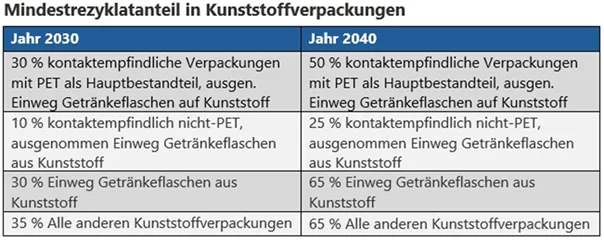
Requirements for minimum recycled content in plastic packaging from the year 2030 (Source: pack.consult)
And here you can access the web seminar series on this topic.
Questions and suggestions welcome to Daniel Wachtendorf ts@innoform.de