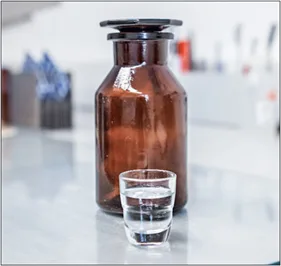
That tastes kind of funny …
Everyone has probably experienced it before. Water that has been sitting in a plastic bottle in a warm car for a while has a strange taste. This or something similar could be the description of a consumer who is not familiar with the sensory testing of food contact materials (FCM, food contact materials). And that’s exactly what we test in our test service in Oldenburg, so that even in a warm car, water has no off-taste.
Sensory testing for assessing compliance with legal requirements for food packaging
At EU level, Regulation (EC) No 1935/2004 (“Framework Regulation”) stipulates that food contact materials (such as flexible packaging, coatings, closures, kitchen utensils, etc.) must be manufactured in such a way that they do not adversely affect the organoleptic properties (taste, but also smell and appearance) of food (Article 3c of the Regulation). This means that in addition to migration testing of the respective material, sensory testing is also necessary to detect any odor or taste deviations. Even when legal migration limits are met, e.g. according to Regulation (EU) 10/2011 (Plastics Regulation), a food can become unusable for the consumer due to off-taste/odor.
Causes of such deviations can be, for example, impurities and/or degradation products of the raw materials used for the manufacture of the material or contaminations from the manufacturing process, which then transfer to food in contact with it and negatively affect the smell and/or taste.
Test persons
At Innoform, the sensory assessment of food contact materials is generally carried out according to DIN 10955. The test is performed by trained test persons, the so-called test panel. This consists of at least six selected testers with the task of achieving at least six results that are consistent with each other. The test persons must be trained in determining sensory deviations (visual, orthonasal, gustatory, retronasal, trigeminal stimuli, etc.) that can be caused by food contact materials. For example, it is regularly checked whether the corresponding basic tastes (sweet, sour, salty, bitter, umami) are recognized and sufficient sensitivity (stimulus threshold, recognition threshold) is present.
The great advantage of human taste/smell is its sensitive perception. Where measuring devices reach their analytical limits, humans can still perceive even the smallest amounts of odor- or taste-active substances.
 |  |
Odor testing
The odor emission of food contact materials (the inherent odor) is not legally regulated and is therefore not mandatory for compliance testing of the material. However, the customer is often the strictest tester, so a noticeable odor can be reason enough not to buy or reject a product or material. Testing for inherent odor can therefore be very useful, e.g. in quality assurance (incoming goods inspection) or in the development of new materials.
Odor testing is carried out using odor-neutral, sealable glass containers into which the sample material is placed and stored according to the requirements of the standard. Subsequently, the sample containers are smelled and the detected odor is evaluated using an intensity scale from 0 to 4. From a score of 2 (weak deviation, definable), a description of the odor (e.g. bitter almond, burnt, etc.) is also given.
Taste testing
For testing the transfer of sensorially perceptible substances to a test food (e.g. water, but also butter cookies, chocolate, fat, etc.), the samples are brought into contact (incubated) with the test food in a suitable manner under defined conditions (temperature/time) and then compared with a reference sample (test food without sample contact).
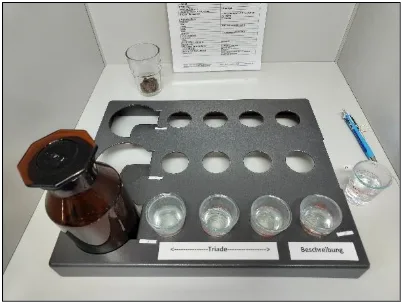
The test is carried out as a so-called coded triangle test, combined with a Difference from Control Test (DfC test) and a simple descriptive test. In a first step, each test person receives three sample glasses (so-called triad), which contain the actual sample and the reference sample. This determines whether a significant difference between sample and reference sample can be detected. Subsequently, the sample is assessed in comparison to the reference using an intensity scale from 0 (no deviation detectable) to four (strong deviation) (DfC test); from a score of 2 (weak deviation), a description of the taste is also given (e.g. sweetish, bitter, etc.).
Assessment scale:
Score 0 = no perceptible taste deviation
Score 1 = just perceptible (still difficult to define) taste deviation
Score 2 = weak taste deviation
Score 3 = clear taste deviation
Score 4 = strong taste deviation
Evaluation of sensory testing
For the evaluation according to DIN 10955, the results of at least six test persons are required. If there are large deviations from each other, individual results can be deleted if the test panel is of a certain size; if this is not possible, the test must be repeated if necessary. The final result is then calculated as the median of all usable results.
According to the 63rd communication of the Federal Institute for Risk Assessment (BfR), the following assessment values are used as recommendations to evaluate from which intensity of deviation or ‘off-taste’ a food is considered “impaired”:
- when testing with original food under typical contact conditions ≥ 2.0 (reaching the recognition threshold)
- when testing with test food under standardized test conditions ≥ 3.0 (clear deviation).
From a score of 3 according to this method, the test should be repeated with the actual intended food under application conditions. From a score of 2 (weak sensory deviation), the cause of the deviation should be determined.
If you have any questions, please contact fcm@innoform.de. We will be happy to prepare a quote for the sensory testing of your material. Or inform yourself online and use our online ordering service.