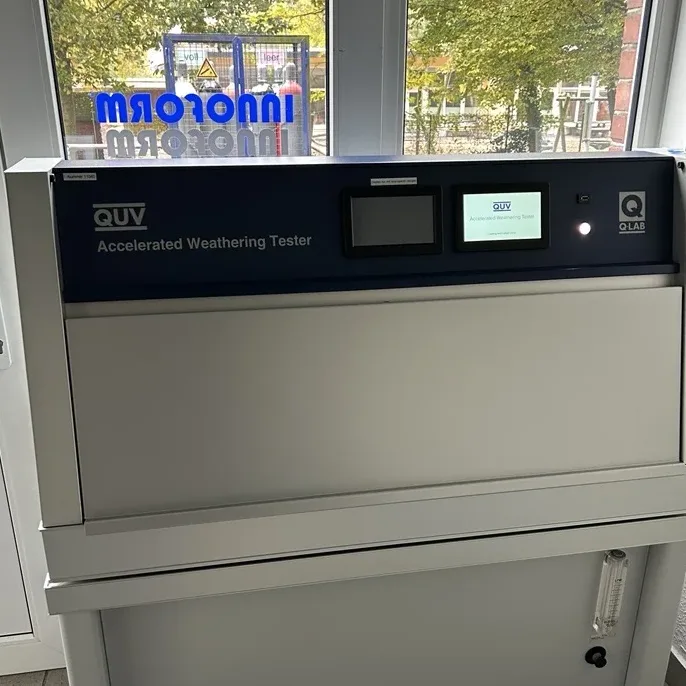
Artificial weathering of films and papers using the Q-UV device to test weather resistance.
Introduction to Artificial Weathering
Artificial weathering is an indispensable method for evaluating the long-term durability of plastics and ensuring their weather resistance. Using modern testing equipment, such as the Q-UV device, damage caused by UV radiation and moisture can be specifically simulated. Through standardized procedures according to DIN EN ISO 4892-3 and DIN EN 14932, realistic aging processes can be efficiently replicated. This method provides essential insights, particularly for applications in the construction, automotive, and agricultural industries. The results significantly support product development and quality assurance.
Artificial weathering of plastics is an essential component of material testing. It serves to assess the long-term durability of materials under the influence of UV radiation, moisture, and temperature, thereby testing their weather resistance. While testing procedures using xenon arc lamps replicate a broad light spectrum, UV fluorescent lamps enable targeted investigations in the short-wave UV range.
Normative Foundations
With the addition of a Q-UV device, standardized tests according to DIN EN ISO 4892-3 and DIN EN 14932 can now be performed. These standards define testing procedures for the artificial weathering of plastics with UV radiation and moisture. The procedure is particularly relevant for applications where plastics are exposed to intensive sunlight, such as in construction, the automotive industry, or especially in agriculture, to test their weather resistance.
Damage Mechanisms Under Artificial Weathering
The Q-UV testing device simulates the damaging effects of UV light and moisture through cyclic exposure of the samples. UV fluorescent lamps are used, which emit in defined wavelength ranges. Radiation in the UV range has a high energy density and is capable of breaking molecular bonds in plastics. This process leads to embrittlement, discoloration, or loss of mechanical properties, which impair weather resistance.
In addition to UV irradiation, the material sample is exposed to moisture in the form of condensation or spray mist at periodic intervals. This cyclic combination of radiation and moisture enables a realistic aging simulation that is highly relevant for various material classes, and also tests weather resistance.
Advantages and Application Areas
- More Precise Aging Simulation: Specific damage mechanisms can be investigated through targeted UV irradiation.
- Standardized Testing Procedures: Fulfillment of requirements according to DIN EN ISO 4892-3 and DIN EN 14932.
- Comparability with Natural Weathering Tests: Artificial weathering enables accelerated evaluation, the results of which can be correlated with outdoor exposure tests.
- Broad Application Spectrum: The method is suitable for plastics, coatings, finishes, and other polymeric materials.
The expansion of testing capabilities through Q-UV complements existing methods of artificial weathering and enables a detailed assessment of material aging under specific conditions. These findings are of critical importance for both product development and quality assurance in various industries, particularly for the assessment of weather resistance.
Further tests on this topic can be found here