Dr. Daniel Wachtendorf
The material characterization of films plays a crucial role in research and industry, particularly in the development and quality assurance of packaging materials, technical films and composite materials. Various proven methods are used to precisely analyze the structure, composition and thermal properties of these materials.
The precise analysis of composite films is essential to understand their structure and properties. They are often used to clarify the following questions:
- Material information: How is the film structured? This question is particularly relevant when the material is unknown – for example, to assess recyclability.
- Avoid confusion: Does the delivered film actually correspond to the ordered specification?
- Error detection in the formulation: Is there a deviation or mix-up in the composition?
- Competitive analysis: Which film variants exist on the market – including those from competitors – for specific applications?
The Innoform Testservice in Oldenburg offers a comprehensive analysis package for precise determination of film structure and material composition. This includes microtome cross-sections, DSC (Differential Scanning Calorimetry), polarization thermomicroscopy and infrared (IR) spectroscopy. With these methods, well-founded findings can be obtained that are indispensable for quality assurance, product development and market analyses.
The first step in analysis
When the customer sample is received, we first create a quick microtome cross-section. This provides an initial overview of the complexity of the sample and serves as a basis for planning further investigations. After we have determined the required analysis effort, we prepare a detailed microtome cross-section and usually examine it under high magnification in transmitted light. This method allows the number of layers, their thicknesses and basic structure to be determined exactly.
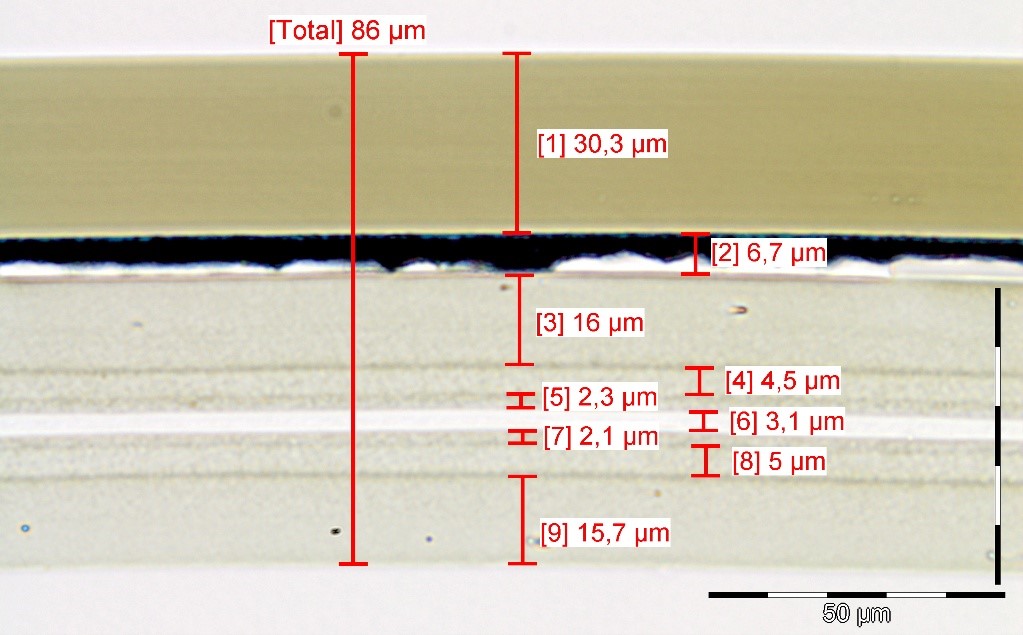
The microtome cross-section of a film
The images created serve not only as guidance for further analyses, but also for clear visualization for the client. Modern microscopes deliver excellent results and are an essential prerequisite for subsequent material characterization. The microtome cross-section thus forms a central component of the analysis and, together with the tabular summary of results, represents the centerpiece of our reports.
Thermal Analysis
The second step is Differential Scanning Calorimetry (DSC), a precise method for thermal analysis of the sample. However, before beginning this investigation, halogens must be excluded. This is done using the Beilstein test, a simple chemical detection method for halogens such as PVC or PVDC. We use the property that halogens produce characteristic green flame colorations in the presence of copper. If the film contains halogens, we subsequently forgo DSC analysis to protect the sensor from the resulting gases.
If the Beilstein test is negative, a thermogram of the sample is created. This provides important thermal parameters such as melting temperatures, melting enthalpies (energy absorption or release) as well as crystallinity and glass transition temperatures. Although DSC does not provide layer-specific results, it offers a comprehensive overview of the thermal properties of the entire sample. Particularly in combination with hot stage microscopy, typical materials such as polyethylene (PE) can be precisely identified.
Analysis of the Melting Behavior of Individual Layers
Another important step in material characterization is hot stage microscopy. This enables detailed investigation of the melting behavior of individual layers of composite films. After preparing a microtome cross-section, the sample is positioned without medium on a glass slide in the transmitted light microscope. There it is gradually heated in a kind of “mini-oven” and continuously observed.
Special polarization filters create a dark field in which semi-crystalline layers become visible as bright areas. Through controlled temperature increase, the melting ranges can be precisely determined. When the melting point is reached, the birefringence disappears, causing the previously bright layers to appear dark. This method allows the thermal properties of individual layers to be accurately determined – even with colored layers, for example with TiO₂, which present a particular challenge.
Chemical Analysis of Composition
To complement the thermal analyses, infrared (IR) spectroscopy is used. This method provides detailed chemical information about the composition of the individual layers. First, the outer layers of the sample are examined using ATR (attenuated total reflectance) spectroscopy. We then prepare a microtome cross-section and place it in a specially developed stainless steel holder for transmitted light measurement.
Using an infrared spectrometer, spectra of the individual layers can be recorded and compared with reference spectra. This investigation complements the thermal analyses and serves as a second verification of the results.
The intermediate layers of a sample can also be analyzed using the IR microscope, resulting in a complete and detailed structure of the composite film.
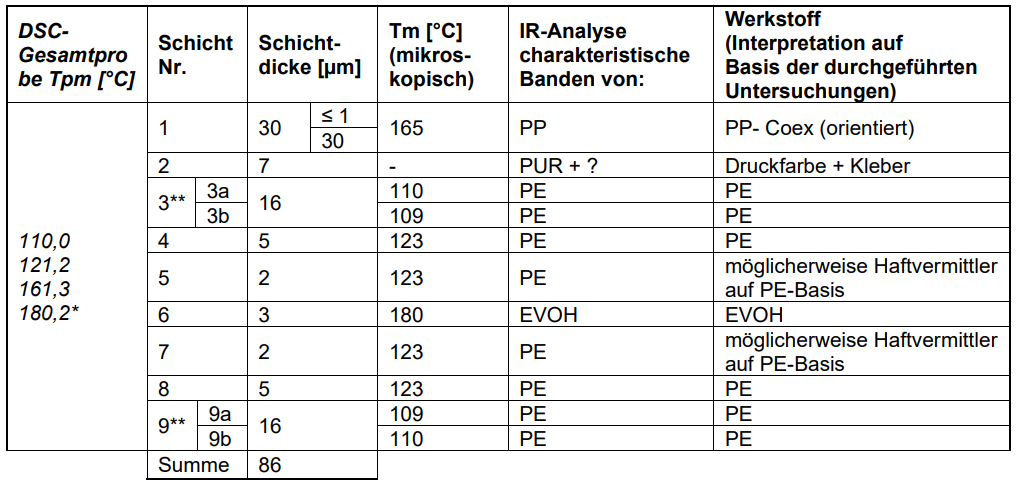
Summary of investigation results of a film
Conclusion: Comprehensive Characterization Through Combined Analyses
Through the combination of mechanical, thermal and chemical analyses, the analysis package from Innoform Testservice offers an opportunity to characterize films in detail. From the first microtome cross-section to the final IR spectroscopy, a comprehensive picture of the material structure and composition emerges. This precise approach not only provides valuable insights for technical and industrial applications, but also sets a high standard in modern film characterization.