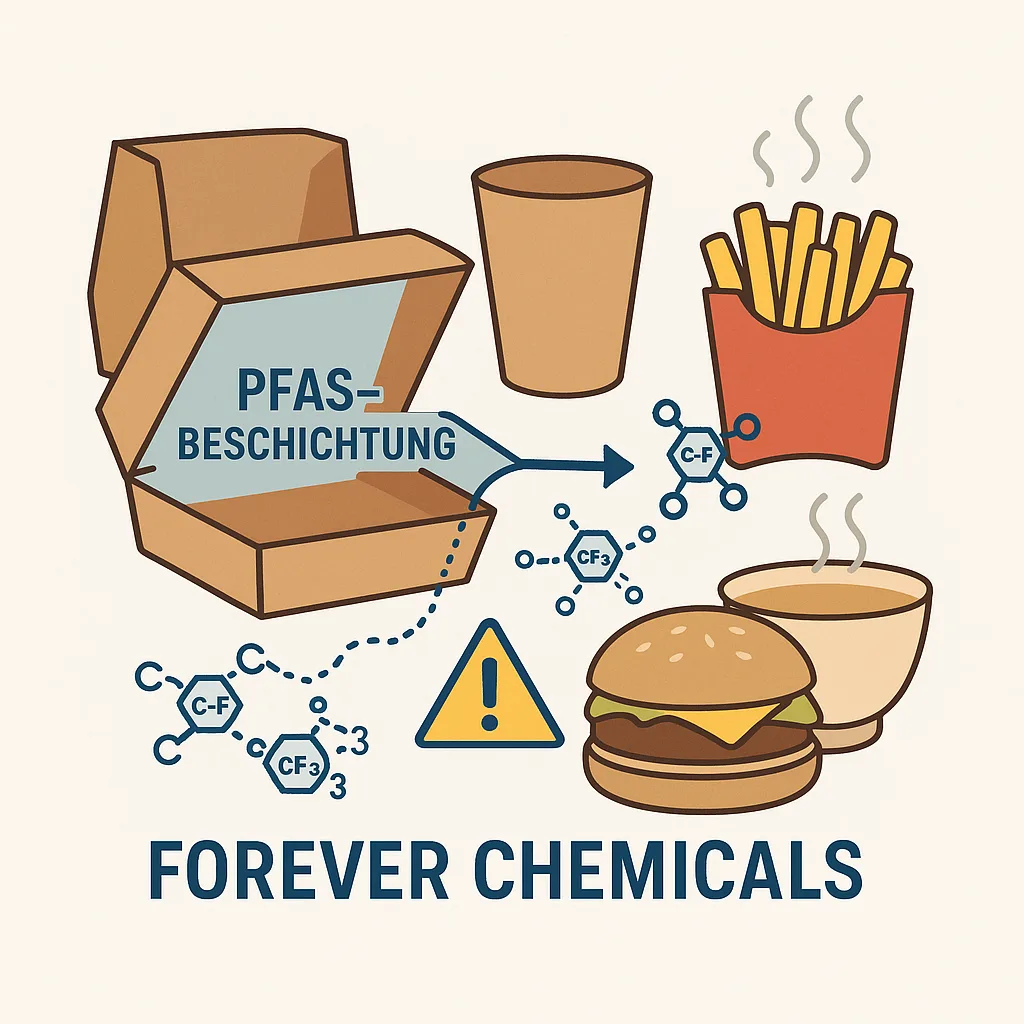
The abbreviation “PFAS” stands for per- and polyfluoroalkyl substances. This is a large group of several thousand chemicals (approximately 5,000 – 15,000 depending on the source of information) that have been used for decades in numerous industrial and consumer applications due to their water-, fat- and dirt-repellent properties. They are particularly common in paper-based food packaging – such as fast food packaging, pizza boxes or microwave popcorn bags. For food contact materials, the most well-known representative of this group is polytetrafluoroethylene, which is used under the trade name “Teflon®” for non-stick coatings on cookware (pots, pans), for example.
At the latest since the entry into force of the “PPWR” (Packaging and Packaging Waste Regulation – Regulation (EU) 2025/40), the topic of PFAS is on everyone’s lips and leads to uncertainty for many about how to deal with these substances.
This article gives you a brief overview of the most important information on the topic of PFAS and answers the question of whether and how you should act as a manufacturer/user of food packaging.
Migration from Packaging into Food
PFAS are particularly problematic because they are chemically extremely stable, i.e. they resist biological degradation, heat, light and chemicals. They are frequently used in paper-based food packaging to ensure moisture and fat resistance, but they are also used in flexible film packaging as extrusion aids or process additives. These “forever chemicals” can then migrate from (coated) packaging into food, especially upon contact with hot, greasy or liquid foods. Studies show that foods from PFAS-coated packaging can absorb significant amounts of these substances or their reaction products.
An important aspect: Even packaging declared as “compostable” or “sustainable”, for example made from molded pulp, often contains PFAS to achieve the necessary barrier properties against fat and moisture. Such materials can release PFAS during composting, which then re-enter the environment and thus potentially back into the food chain via soils, plants or animal feed.
Health Risks and Alternatives
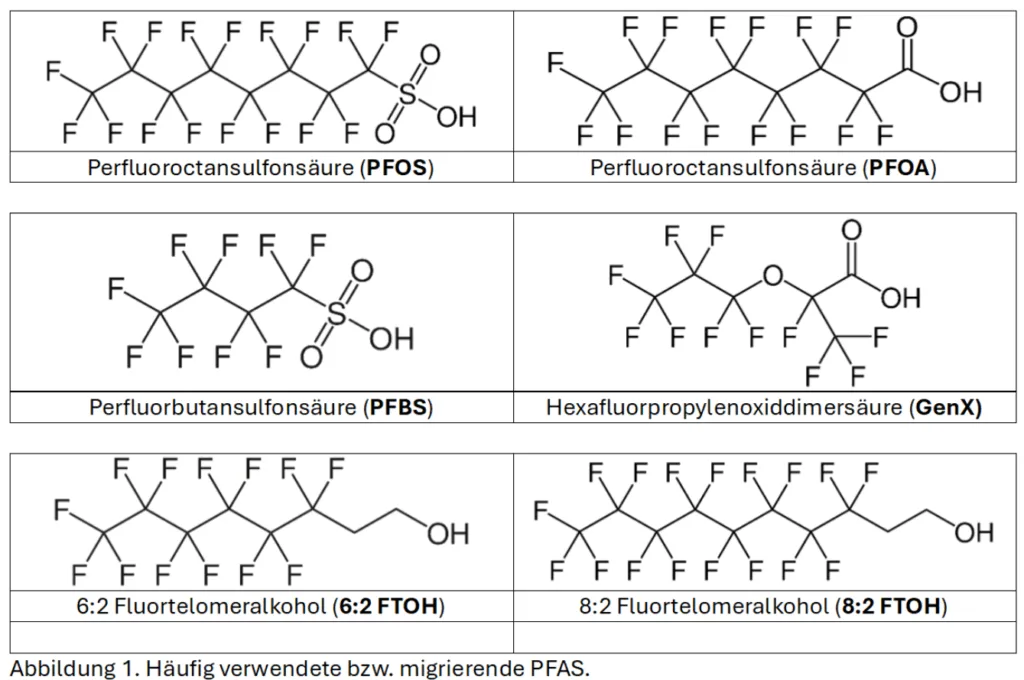
PFAS are extremely persistent and bioaccumulative, accumulating primarily in blood, liver and lungs. The majority of human exposure occurs through diet, according to estimates around two thirds, as well as through drinking water and house dust. The chronic intake of PFAS through contaminated food poses an ever-growing risk. The health risks are now well documented, especially long-chain PFAS (e.g. PFOA, PFOS) are associated with health problems such as reproductive disorders, immunosuppression and tumor formation. But even newer, short-chain alternatives such as GenX (named after the manufacturing process) or PFBS show toxicological effects and are critically evaluated due to their high mobility and environmental persistence. (G. Glenn et al. Per‑ and polyfluoroalkyl substances and their alternatives in paper food packaging. Comprehensive Reviews in Food Science and Food Safety, 2021)
Given the known risks, there is a growing need for PFAS-free, functionally equivalent but also biodegradable packaging solutions. Alternatives currently being tested, for example based on polysaccharides (e.g. starch, chitosan), proteins or polylactic acid (PLA), have so far achieved only limited success in achieving the desired fat and moisture barrier properties.
Analytical Challenges
The challenge in PFAS analysis lies in their structural diversity and the low concentration in which they occur. Modern analytical methods such as liquid chromatography coupled with high-resolution mass spectrometry (LC-QTOF, LC-MS/MS) enable the detection of even the smallest amounts in various matrices, including food and environmental samples. These systems also allow the identification of previously unknown PFAS or degradation products – an important prerequisite for regulations and risk assessments. However, these methods cannot ensure that all PFAS are detected and quantified, so the total fluorine content is often determined by combustion in an oxygen bomb and ion chromatography. However, this does not separate inorganic and organic fluorides, so misinterpretations are possible.
PPWR: A Regulatory Turning Point
Regulation (EU) 2025/40, a central EU initiative on the circular economy, provides comprehensive regulations for packaging with the aim of significantly reducing packaging waste by 2040 and making materials safe and recyclable. Particularly relevant: the PPWR contains clear requirements for the safety of food contact materials.
The current regulation text explicitly targets the reduction of “substances of concern” in packaging – PFAS are in focus. Manufacturers must in future demonstrate that their packaging is free from persistent, bioaccumulative and toxic substances such as PFAS. Thus, after the expiry of the transition period on 12.08.2026, food packaging may no longer be placed on the market if it contains PFAS in the following concentrations:
- 25 ppb for each individually analyzed PFAS (excluding polymeric PFAS)
- 250 ppb for the sum of PFAS, measured as the sum of targeted analysis and, where applicable, degradation of precursor compounds (excluding polymeric PFAS)
- 50 ppm for PFAS (including polymeric PFAS); if the total fluorine content exceeds 50 mg/kg, the producer or importer must provide evidence of the amount of measured fluorine upon request.
These regulations are particularly relevant for manufacturers of food packaging, who can already check whether action is needed by measuring the total fluorine content.
If you have any questions, please contact fcm@innoform.de. We will be happy to provide you with a quote for the determination of total fluorine content.
You can find tests for PFAS here.
An article by Dr. Tim Schlüter