At a glance
INNOFORM Testservice extends the OTR measurement according to ISO 15105-2 with a variant using 100 % oxygen as the permeant. This lowers the limit of quantification for oxygen transmission by a factor of 5 — a decisive advantage for high-barrier packaging in pharma, food and technical applications whose permeation rates can no longer be reliably resolved with standard tests (21 % O₂ from air).
When standard methods are no longer enough for ultra-high barriers
Precise measurement of the oxygen transmission rate (OTR) is becoming increasingly challenging for modern high-barrier packaging. Standard methods reach their limits with extremely low permeation rates. INNOFORM Testservice therefore extends the OTR test according to ISO 15105-2 by using 100 % oxygen — for significantly higher sensitivity and reliable measurement results even in the lowest measuring range.
Extremely low oxygen transmission rates can hardly be measured under conventional test conditions — the measured flux lies close to the instrument’s quantification limit and the measurement uncertainty dominates the result.
Our approach: more sensitivity through 100 % oxygen
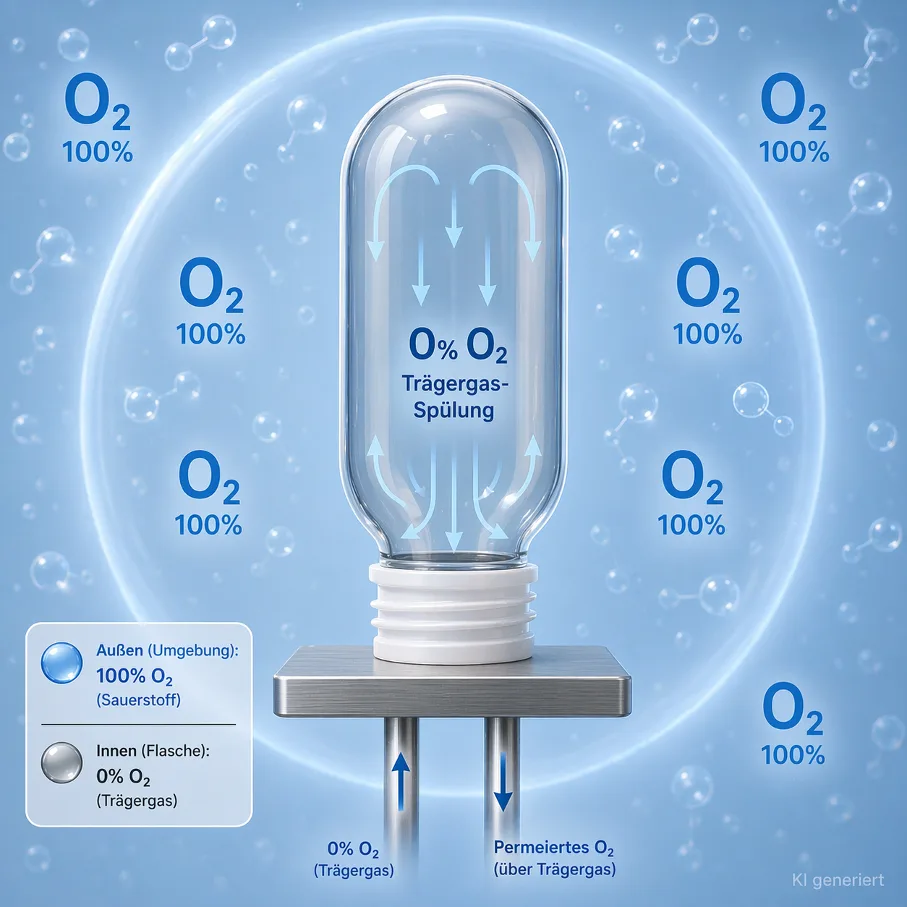
To reliably detect even the smallest permeation rates on finished packaging or closures, we deliberately use pure oxygen as the permeant in the test according to ISO 15105-2.
The principle is simple — the effect is decisive:
A significantly increased oxygen partial pressure raises the measurable flux without distorting the material behaviour.
Your benefit: clarity where others hit the wall
These optimised test conditions yield a quantification limit reduced by a factor of 5.
For you, this means:
- Reliable measurability of extremely low OTR values
- Precise comparability of high-barrier materials
- Sound decision basis for development and quality assurance
In sensitive areas such as pharma, food or technical applications, this additional accuracy becomes a decisive competitive advantage.
Conclusion
With our extended OTR test, we create differentiation where standard methods are no longer sufficient and provide you with the data you need — for example, to calculate the best-before date of your packaged food products.
Frequently asked questions about OTR measurement for high-barrier packaging
What does OTR mean?
OTR stands for Oxygen Transmission Rate — the oxygen permeability of a packaging material. It describes how much oxygen migrates through a film or packaging per unit area and time, usually expressed in cm³/(m²·d·bar). For high-barrier films, values are often below 1 cm³/(m²·d) — close to the resolution limit of classical methods.
Why 100 % oxygen instead of ambient air?
In atmospheric air, the oxygen partial pressure is around 0.21 bar. With pure oxygen, it rises to 1 bar — the driving concentration gradient is multiplied by five. Since permeation is proportional to the partial pressure difference (permeation mechanism), the measurable flux also becomes five times larger. The material-specific permeability remains unchanged; only the measurement signal moves clearly above the quantification limit.
Which types of packaging benefit from the method?
Especially high-barrier packaging for pharma, MAP food (modified atmosphere packaging), oxygen-sensitive diagnostics and technical applications. Typical examples: metallised laminates, EVOH-containing multilayers, SiOx- or AlOx-coated films and aluminium composite films — tested on finished pouches, bottles, cups and closures.
Are the results still comparable with ISO 15105-2?
Yes. The test is still performed according to ISO 15105-2; only the permeant concentration is raised to 100 % O₂. Climate, sampling and evaluation remain compliant with the standard. On request, we report the value both at 1 bar partial pressure and — via linear conversion — as an equivalent air value (21 % O₂), to ensure comparability with historical data and supplier specifications.