The assessment of food contact materials (FCM) requires not only knowledge of the intentionally added substances (IAS), but also of the unknown substances that may be hidden in the materials.
NIAS in Legislation
So-called NIAS (non-intentionally added substances) are substances that are not intentionally used during the manufacturing process, but may inevitably be present in the (finished) material and therefore must also be systematically evaluated to ensure general food safety.
In Regulation (EU) No 10/2011 (Plastics Regulation), non-intentionally added substances are defined as “an impurity in the substances used or a reaction intermediate formed during the manufacturing process, or a degradation or reaction product”. At the same time, the regulation states that non-intentionally added substances may be present in plastic materials or articles and that the declaration of compliance for the respective material must provide “sufficient information on the presence of non-intentionally added substances”.
Accordingly, it is already assumed here that NIAS may be present in materials, but the assessment is the responsibility of the manufacturers/suppliers.
Where Do NIAS Come From?
The presence of NIAS can have various causes and occur along the entire value chain. Often they are degradation products of the polymers used (e.g. shorter-chain oligomers, acetaldehyde from PET), oxidation products of additives used (e.g. antioxidants and stabilizers), contaminations from the manufacturing process (e.g. lubricants) or from the raw materials used, but recycling-related inputs when using/manufacturing recycled material are also possible.
Identification of NIAS
The basis for a (risk) assessment in all cases is the identification and quantification of the respective substances. If it is already known in advance or suspected which substances typically occur (can occur) as NIAS, then a targeted analysis is possible (e.g. specific migration of acetaldehyde from PET).
However, since NIAS are usually unknown and often unlisted substances with very different chemical properties, the analysis is generally carried out by means of non-target analysis, i.e. a non-targeted screening of a migration solution of the respective food contact material. The complex mixture of substances is separated using chromatographic separation methods (e.g. gas chromatography, liquid chromatography) and quantified using internal standards.
The identification of the detected substances is carried out by means of mass spectrometry, the data obtained (mass fragmentation) are compared and evaluated using commercial and in-house laboratory databases. If a substance cannot be identified more precisely, e.g. because insufficient data is available, it is necessary to investigate its origin more closely. It is often helpful to contact suppliers or to examine the process more closely. Often the unknown substances are impurities or by-products or degradation products of the raw materials used; contamination during the manufacturing process is also a possible source.
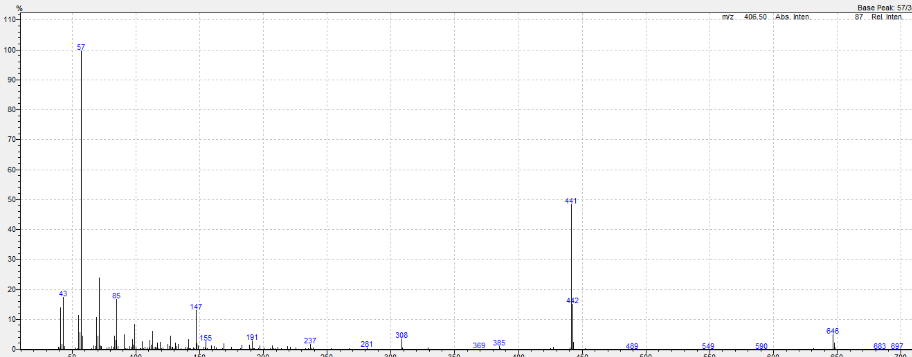
Figure 2. Typical mass fragmentation of an additive (e.g. Irgafos 168®).
Legal and Toxicological Assessment
Although NIAS are already mentioned in the Plastics Regulation, there are no legal limit values for these substances in general. Manufacturers and distributors are obliged to carry out a (risk) assessment, even if the substances are not listed or previously known.
In practice, an initial assessment value of 10 µg/kg food (equivalent to 10 ppb) is initially used. This is based on regulations for the migration of substances through a functional barrier, where non-approved but intentionally added substances may be used behind a functional barrier, provided that their migration is not detectable with a detection limit of 0.01 mg/kg food. Excluded from this are substances that are classified as carcinogenic, mutagenic or toxic to reproduction (so-called CMR substances) and/or are present as nanoparticles. Since genotoxicity cannot be ruled out at first for initially unknown, non-intentionally added substances, the estimated 10 µg/kg food is significantly higher than the value of 0.15 µg/kg food provided for this substance group according to the TTC concept (Threshold of Toxicological Concern) and is therefore to be regarded as more of a pragmatic means than a specific toxicological assessment value.
Substances that are detectable above this detection limit of 10 ppb (“10 ppb screening”) must then be identified and evaluated accordingly. In the case of listed substances, the assessment is often quite simple, as the respective specific migration limit (SML) can be used for the assessment. However, since NIAS are usually unlisted substances, a risk assessment “according to internationally recognized scientific principles” (Article 19 of the Plastics Regulation) is necessary. The assessment of the respective substance is usually based on specific toxicological data and evaluations (e.g. by EFSA, BfR), computer-aided models (in the absence of experimental data) or exposure assessments and genotoxicity tests.
Conclusion
NIAS represent an unavoidable but manageable component of food contact materials. A thorough analytical strategy, combined with a scientifically sound toxicological assessment, is crucial to ensure compliance and product safety and to meet the requirements of EU legislation.
If you have any questions, please contact fcm@innoform.de. We will be happy to prepare a quote for a NIAS analysis of your material.