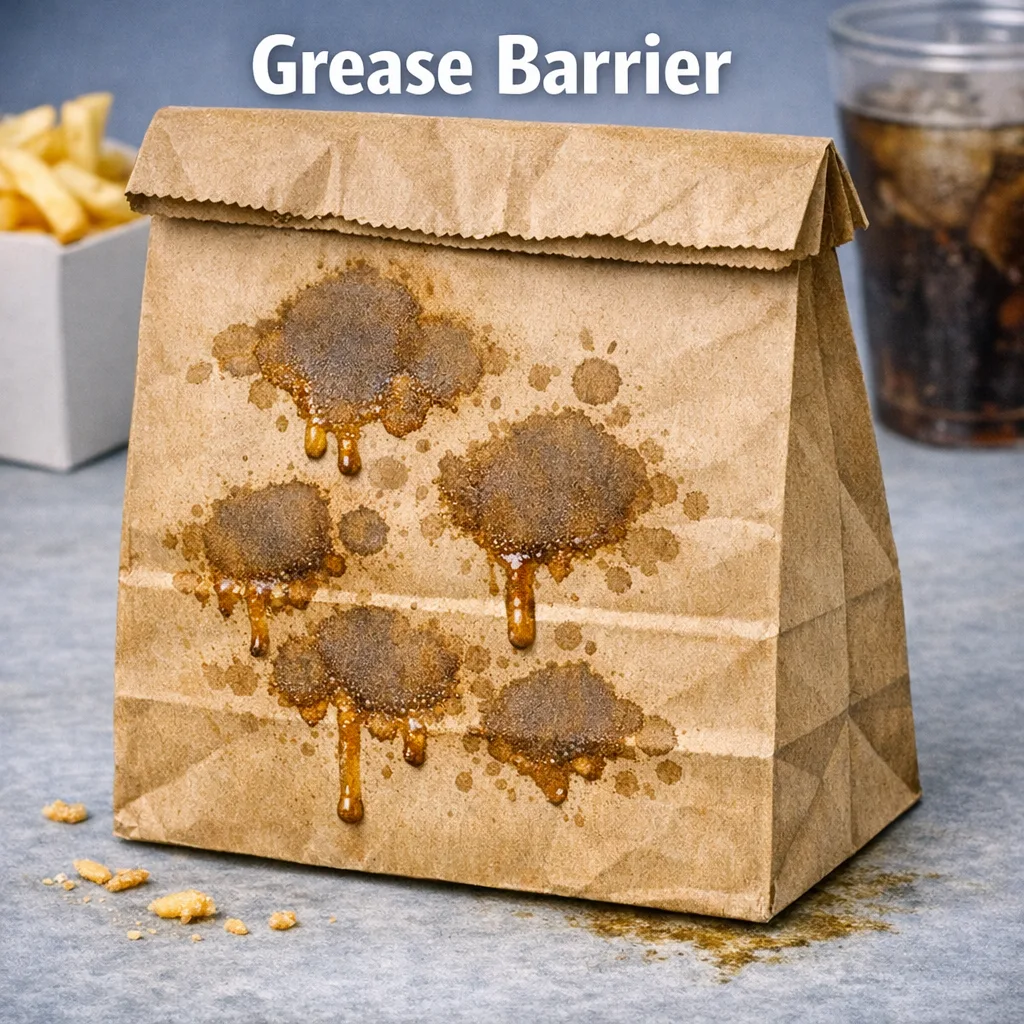
Fatty foods pose particular challenges for packaging. Fats can penetrate materials, affect their appearance or cause problems from the very first contact. This is precisely why tests such as fat resistance, fat permeability and fat repellency play a central role – both in development and in quality assurance.
In this context, two fundamental perspectives can be distinguished:
- Barrier effect (fat resistance & fat permeability) → Behaviour within the material
- Fat repellency (lipophobia) → Behaviour on the surface
It is only the combination of these two approaches that allows for a realistic assessment.
Fat resistance and fat permeability: the barrier is the deciding factor in the long term.
Together, fat resistance and oil permeability describe a material’s ability to retain oil and limit its passage.
- Fat permeability indicates how easily and how quickly fat migrates through a material
- Fat tightness answers the question of whether this barrier is sufficient for the application
Why is this relevant?
In practical use, the main focus is on the long-term effect:
- Protection of the product throughout its entire storage period
- Prevention of grease migration and structural material failure
- Ensuring the functional properties of the packaging
Key question:
Does the material reliably repel fat?
Oil repellency (KIT test) – the surface is the first point of contact
Fat repellency describes the behaviour of fat on the surface of the material.
- Fat can either be rejected or
- it wets and penetrates
The KIT test provides a standardised assessment of this via a parameter (KIT level).
Why is this relevant?
The user interface often determines the first impression and short-term performance:
- Preventing visible fat stains
- Impact on consumer perception
- Protection against initial wetting and the resulting penetration
Key question:
What happens when fat first comes into contact with the packaging?
Structure vs. surface – two sides of the same coin
| Property | Fat tightness & permeability | Fat repellency (KIT) |
| Focus | Material structure | Surface |
| Statement | Migration patterns | Wetting resistance |
| Time horizon | Long-term review | Quick test |
| Meaning | Functional barrier | Appearance & First impression |
Why both tests are necessary in practice
A high KIT value alone does not guarantee high fat density. Fat behaviour is always the result of several factors – and that is precisely why it is so important to consider them together:
- Good fat repellency can delay grease from sticking, but it cannot replace a barrier
- Good barrier properties delay penetration, but do not necessarily prevent staining
- Materials – particularly paper-based ones – often exhibit time-dependent behaviour
Typical practical implications
- Complaints: visible fat stains despite adequate protection
- Quality issues: Fatting during prolonged storage, Sensory impairment
- Process disruptions: Fat affects sealing, adhesion, mechanical stability or handling
This interaction is becoming increasingly important, particularly in the context of sustainable packaging solutions (e. g. paper-based systems).
Classification by application
- Product development:
A combination of barrier assessment and surface analysis
- Quality assurance:
Clear requirements regarding grease density, supplemented by KIT values
- Material optimisation:
Targeted adaptation of coatings and structures
Conclusion
The assessment of fat behaviour can be boiled down to two key questions:
- What happens within the material? → Oil resistance & oil permeability
- What happens on the surface? → Fat repellency
These two aspects are inextricably linked. Only by considering them together can we develop packaging that is both functional and visually appealing – from the very first encounter through to long-term use.